

Fragrance Free Spray for Pet Owners: Top Picks
Table of Contents
- Why Fragrance Free Spray for Pet Owners Matters
- Quick Comparison: Zero Smell Spray Options for Pet Odors
- How to Neutralize Pet Urine Smell in Carpet
- Non-Toxic Pet Odor Spray: What to Look For
- Top Fragrance Free Spray Options for Pet Owners
- Safety Considerations for Sensitive Pets and Kids
- Conclusion: Choosing the Right Fragrance Free Spray
- Frequently Asked Questions
Last Updated: September 15, 2026
Why Fragrance Free Spray for Pet Owners Matters
Pet odor signals what's happening on a molecular level, and covering it with perfume solves nothing. A fragrance free spray for pet owners targets the source of the smell instead of layering a scent on top.
Synthetic fragrance is one of the most common triggers for contact irritation in pets and a frequent culprit behind headaches and respiratory discomfort in children (pubmed.ncbi.nlm.nih.gov). Spraying a scented deodorizer on a dog bed or a carpet your toddler crawls on adds a chemical layer to a surface already holding dander, saliva, and tracked-in dirt. That's why more pet owners are switching to unscented, non-toxic formulas that break odors down instead of hiding them.
This guide from Zero Smell covers what works, what to avoid, and how to pick a spray that's safe for the whole household.
Quick Comparison: Zero Smell Spray Options for Pet Odors
Zero Smell's line runs from a single mini bottle to a full gallon, all built on the same bio-based, unscented formula.
| Product | Size | Price | Best For |
|---|---|---|---|
| Z-Smell On The Go (Single) | 3.38 oz | $9.98 | Testing the formula, car use |
| Z-Smell On The Go (3 Bundle) | 3 x 3.38 oz | $23.98 | Multiple rooms, travel kits |
| Z-Spray | 16.9 oz | $19.98 | Everyday pet bed and carpet use |
| Z-Spray Large | 33.8 oz | $34.98 | Multi-pet households |
| 2 Medium Sprays + 3 Minis | 2 x 16.9 oz + 3 minis | $39.98 | Whole-home coverage |
| 1 Gallon | 128 oz | $69.98 | Heavy recurring use |
| 2 Gallon + 1 Z-Spray | 2 gal + 16.9 oz | $139.98 | Shelters, fosters, large homes |
Every option uses the same unscented, alcohol-free, non-toxic formula. The only difference is volume and packaging.

How to Neutralize Pet Urine Smell in Carpet
Urine odor comes from uric acid crystals that bind to carpet fibers and reactivate with humidity (pubmed.ncbi.nlm.nih.gov). Surface cleaning removes the liquid but leaves the crystals, which is why the smell returns on damp days.
Here's the sequence that actually works:
- Blot fresh urine with a clean cloth, pressing down rather than rubbing.
- Rinse the area with cool water and blot again. Avoid heat, which sets the odor.
- Apply an enzyme-based or bio-based neutralizer generously. These formulas break down the uric acid rather than masking it.
- Let it sit for the contact time listed on the label, then blot dry.
- Air-dry completely before walking on the area.
A fragrance free spray for pet owners is the better choice here because scented products add perfume to a damp, reactive surface. Zero Smell's formula uses beneficial microorganisms to break down odor compounds, so it works on set-in odors, not just fresh ones.

Non-Toxic Pet Odor Spray: What to Look For
A non-toxic pet odor spray should be unscented, alcohol-free, and free of synthetic fragrance, parabens, and sulfates. Those criteria eliminate most ingredients that trigger reactions in sensitive pets and children. But "non-toxic" isn't regulated on pet product labels, so read the ingredient panel line by line.
Ingredients to avoid in pet grooming and deodorizing products
- "Fragrance" or "parfum": A single word on a label can legally stand in for dozens of undisclosed compounds, including phthalates used to extend scent life. This is the number-one trigger for contact irritation in pets.
- Essential oils: Lavender, tea tree, citrus, peppermint, eucalyptus, and wintergreen are common in "natural" pet sprays. Cats lack the liver enzymes to metabolize many of these compounds, and tea tree oil is well documented as toxic to cats even at low concentrations (The Essentials of Essential Oils Around Pets). Essential oils count as fragrance, not a safe alternative.
- Alcohol (ethanol, isopropyl, denatured): Dries out the coat and skin barrier, stings cracked paws, and flashes off as a respiratory irritant.
- Parabens (methylparaben, propylparaben, butylparaben): Preservatives linked to endocrine disruption in lab studies; many pet owners avoid them even where pet-specific evidence is thin.
- Sulfates (SLS, SLES): Harsh surfactants that strip the skin's lipid layer and worsen itching in pets with existing dermatitis.
- Phthalates: Often hidden inside "fragrance," used as fixatives; associated with respiratory and reproductive concerns.
- Phenols and quaternary ammonium compounds (quats): Common in household disinfectants that get repurposed as pet sprays; both are irritants and, in cats, can be seriously toxic.
- Bleach, ammonia, and hydrogen peroxide at disinfecting concentrations: Fine for some hard surfaces, but not for anything a pet will lie on, lick, or breathe near.
What "hypoallergenic" actually means on a pet product
No government standard governs "hypoallergenic" for pet products the way it does for some human cosmetics. In practice it means the formula avoids the most common irritants, synthetic fragrance, dyes, alcohol, and essential oils. That's a useful shorthand, not a guarantee: a pet can react to a preservative, a surfactant, or a botanical extract no one flagged. Treat "hypoallergenic" as a starting filter, not a finish line.
What to check on the label
- Scent: Truly fragrance-free, not "lightly scented," "natural fragrance," or "essential oil blend." All three of those phrases mean fragrance is present.
- Alcohol content: Skip it. Alcohol dries out coats and can sting paws.
- pH balance: Pet skin sits around pH 6.5-7.5, so a dramatically acidic or alkaline spray will disrupt the skin barrier over repeated use. Look for pH-balanced formulas safe on fabric, fur, and hard surfaces.
- Active mechanism: Look for enzymes or bio-based microorganisms. These neutralize odor instead of masking it.
- Surface compatibility: A good spray should work on carpet, upholstery, pet beds, car interiors, and kennels without staining or leaving residue.
- Full ingredient disclosure: If the label hides behind "proprietary blend" or "fragrance," assume the worst and move on.
Zero Smell's formula meets these criteria: No synthetic fragrance, no alcohol, no parabens, no essential oils.
Top Fragrance Free Spray Options for Pet Owners
Zero Smell's lineup gives pet owners a fragrance free spray for pet owners at every price and volume, from a $9.98 mini to a $69.98 gallon.
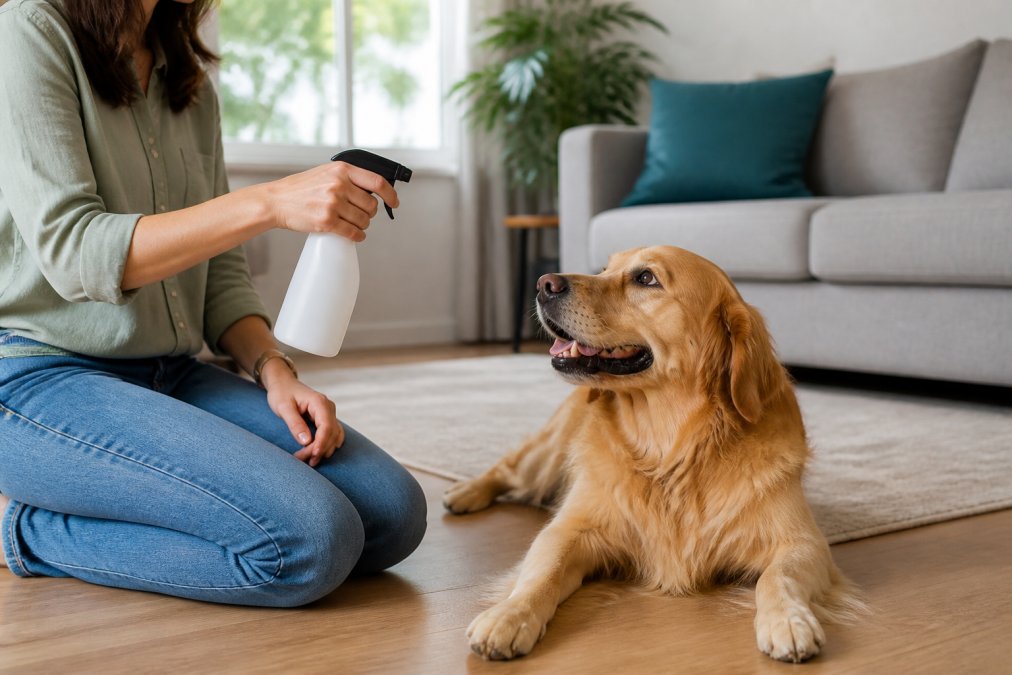
Z-Smell On The Go (Single), $9.98 The 3.38 oz mini is the entry point: testing the formula on one problem area, keeping in a car for pet transport odors, or tucking into a diaper bag or gym bag.
Z-Spray 16.9 oz, $19.98 The standard bottle and best starting point for most pet owners. Handles pet beds, blankets, litter boxes, carpet spots, and couch cushions.
Z-Spray 33.8 oz, $34.98 For multi-pet households or anyone treating carpet and upholstery regularly. Same formula, double the volume, better cost per ounce.
2 Medium Sprays + 3 Minis Bundle, $39.98 The practical whole-home kit. Two full-size bottles for the main living areas and three minis for cars, travel, and lockers.
1 Gallon, $69.98 Best for fosters, shelters, or recurring heavy odor problems. Refill-oriented and the lowest cost per ounce in the lineup.

2 Gallon + 1 Z-Spray, $139.98 Built for volume users running multiple treatment areas daily.
Z-Pouch & Case, $19.98 A non-spray option for enclosed spaces: litter box areas, kennels, storage bins, and gym lockers. Place the pouch, and the minerals and microorganisms work continuously.
Safety Considerations for Sensitive Pets and Kids
The skin barrier is the part most guides skip
How to patch-test a new spray on your pet
Interaction with topical flea and tick preventatives
What that means in practice:
Other safety considerations
Conclusion: Choosing the Right Fragrance Free Spray
Frequently Asked Questions
How can I make my house smell good without harming my dog?
Use a fragrance free spray for pet owners that eliminates odors at the source instead of masking them. Look for bio-based formulas with no synthetic fragrance or essential oils. Products like Zero Smell's Z-Spray use microorganisms to break down odor molecules, making them safe around pets and children. Always check the label for non-toxic, alcohol-free claims before spraying near your dog's bedding or living areas.
What is the safest air freshener for pets?
The safest option is a non-toxic pet odor spray that contains no synthetic fragrance, essential oils, or harsh chemicals. Bio-based formulas that use beneficial microorganisms to neutralize odors are a top choice. Avoid aerosol sprays and products listing phthalates or artificial perfumes. Zero Smell's spray is unscented, alcohol-free, and safe for use around animals, making it a reliable pick for households with sensitive pets.
How do I neutralize pet urine smell in carpet?
First, blot up as much urine as possible with a clean cloth. Then apply a fragrance free spray that breaks down odor-causing compounds at the source. Zero Smell's bio-based formula uses microorganisms to destroy the chemical bonds that create ammonia odor. Spray generously on the affected area and let it air dry. For deep-set stains, repeat the process after the carpet is fully dry to ensure complete odor elimination.
Are essential oils in pet sprays dangerous?
Yes, many essential oils are toxic to pets, especially cats and small dogs. Even diffused oils can cause respiratory issues. A fragrance free spray for pet owners avoids this risk entirely by using no essential oils or synthetic fragrance. Choose products labeled non-toxic and veterinarian-recommended when possible. Zero Smell's sprays contain no essential oils, making them a safer choice for homes with pets.
How does a bio-based odor eliminator work compared to masking sprays?
Masking sprays cover up odors with strong fragrance, but the smell often returns once the fragrance fades. Bio-based odor eliminators like Zero Smell use beneficial microorganisms to break down the source of the odor, including ammonia and sweat compounds. This means the smell is gone, not hidden. For pet owners, this approach is more effective for stubborn odors like urine or wet dog smell.