

How to Get Smell Out of Car: 7 Steps That Work
Table of Contents
- Step 1: Find the Source of the Smell
- Step 2: Clear Out Trash and Vacuum Debris
- Step 3: How to Deep Clean Car Upholstery
- Step 4: Clean the HVAC System and Cabin Air Filter
- Step 5: How to Remove Smoke Smell from Car
- Step 6: Best Odor Eliminator for Cars
- Step 7: Prevent Smells from Coming Back
- Frequently Asked Questions
Last Updated: September 29, 2026
Step 1: Find the Source of the Smell
Knowing how to get smell out of car interiors starts with finding the source. Odors come from organic matter, moisture, or mildew, and each needs a different fix, so work backward from the smell.
Match the Smell to the Source
Use the odor itself as your first clue. This table maps common car smells to their likely source.
| What it smells like | Likely source | Where to check first |
|---|---|---|
| Musty, wet basement | Mildew from trapped moisture | Trunk and spare tire well, then passenger carpet |
| Sour milk or garbage | Spilled food or drink, bacteria | Under seats, seat rails, child seat anchors |
| Sweet, syrupy | Coolant leak (ethylene glycol) | Passenger floorboard near the heater core |
| Rotten eggs | Sulfur from the catalytic converter or battery | Engine bay, then under the rear seats |
| Acrid, burnt | Electrical short or overheated wiring | Under the dash, fuse box area |
| Stale cigarette | Smoke residue in fabric and HVAC | Headliner, seats, cabin air filter |
| Wet dog or gym bag | Pet dander, sweat, damp gear | Cargo area, seat cushions, floor mats |
| Gasoline | Fuel system leak | Trunk, fuel filler area, engine bay |
Run the Zone-by-Zone Sniff Test
Once the smell type narrows your search, confirm the location:
- Sniff test by zone. Check the trunk, under seats, floor mats, and door pockets one at a time.
- Check for food and spills. Old crumbs and spilled drinks feed bacteria that produce a sour smell.
- Look for moisture. Damp carpet or a wet trunk liner often means mildew.
- Run the vents. If the smell hits when you turn on the heat or AC, the problem is in the HVAC system.
- Note the type of odor. Smoke, pet, mildew, and food smells each point to a different source.
Step 2: Clear Out Trash and Vacuum Debris
Removing trash and vacuuming debris is the fastest win in the whole process. You cannot deodorize a surface covered in crumbs, pet hair, and old food. Empty every compartment, then vacuum thoroughly.
- Pull out floor mats and shake them outside.
- Vacuum seats, carpet, and the gaps between seats and the console.
- Use a crevice tool for seat rails and under-seat areas.
- Hit the trunk and spare tire well.
- Empty the glovebox and door pockets.
Step 3: How to Deep Clean Car Upholstery
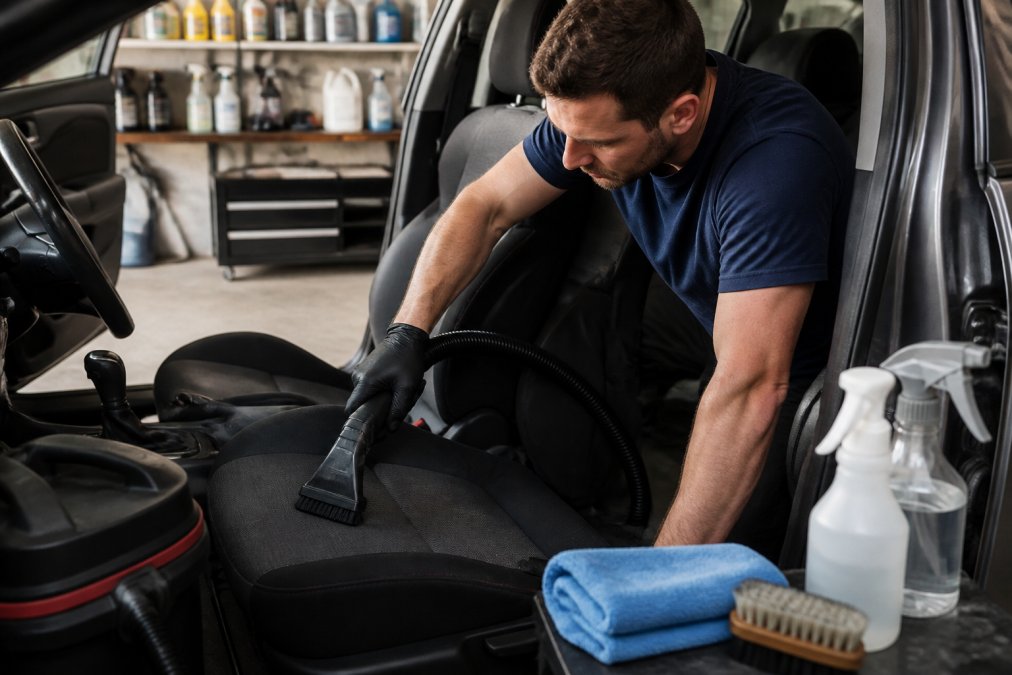
Deep cleaning car upholstery removes the residue that holds odor in fabric fibers. The method depends on your seat material, so treat fabric and leather differently.
Fabric Seats and Carpet
Fabric holds spills, sweat, and pet accidents deep in the padding, where surface wiping does nothing.
- Vacuum the fabric first to lift loose dirt.
- Mix a small amount of fabric cleaner with water.
- Test it on a hidden spot before you use it everywhere.
- Work the cleaner in with a soft brush.
- Blot with a clean cloth. Do not soak the fabric.
- Let it dry fully with the windows open.
Leather and Vinyl Surfaces
Leather and vinyl need a gentler touch. Harsh cleaners strip the finish and cause cracking.
- Wipe with a damp cloth and a mild leather cleaner.
- Avoid alcohol-based products that dry the surface.
- Follow with a leather conditioner to keep it soft.
- Clean seams and stitching, where grime collects.
Step 4: Clean the HVAC System and Cabin Air Filter
A dirty cabin air filter and HVAC system push stale air and mildew spores into the cabin every time you drive. If the smell returns when you run the vents, this is your source.
The fix is straightforward:
- Find the cabin air filter, usually behind the glovebox.
- Pull it out and check for leaves, dust, and dark spots.
- Replace it if it looks clogged or damp.
- Run the fan on high with the windows down.
- Spray an odor neutralizer into the air intake, near the wiper cowl.
- Switch to recirculate mode and let it cycle for a few minutes.
Step 5: How to Remove Smoke Smell from Car
Smoke smell is the hardest odor to remove because it soaks into every soft surface, fabric, foam, headliner, and the HVAC system. Thirdhand smoke, the residue that clings after the smoke clears, is why a car can still smell months after the last cigarette. Air fresheners only add fragrance on top of smoke, and the mix smells worse. You have to remove the residue, not cover it.
Work From the Top Down
Smoke residue settles downward, so clean the highest surfaces first. If you start with the carpet, you re-contaminate it when you reach the headliner.
- Vacuum the headliner with a soft brush attachment. Use light pressure, the adhesive holding the fabric to the roof can fail if you scrub.
- Vacuum the seats, including the seams and the gap between the cushion and the backrest.
- Wipe hard surfaces: dashboard, door panels, and trim.
- Clean the inside of the windows. Smoke leaves a film that holds odor and cuts visibility at night.
- Replace the cabin air filter.
- Treat fabric and carpet with an odor neutralizer.
- Let the car air out with windows down for several hours.
Match the Cleaner to the Surface
Smoke residue is greasy, so water alone won't lift it, but the wrong cleaner can do permanent damage. This is the step most guides skip.
| Surface | Safe approach | Avoid |
|---|---|---|
| Fabric seats and carpet | Enzyme or bio-based neutralizer, worked in with a soft brush | Bleach, ammonia, or anything that leaves the fabric soaked |
| Leather seats | pH-neutral leather cleaner, then a conditioner | Alcohol, all-purpose degreasers, and household vinegar, all strip the finish and cause cracking |
| Vinyl and hard plastic | Diluted mild soap on a microfiber cloth | Abrasive pads and solvent-based cleaners that dull the finish |
| Headliner | Dry vacuum only, or a barely damp cloth | Wet cleaning, which loosens the adhesive |
| Touchscreen and dash electronics | Dry microfiber, or a screen-safe wipe | Spraying liquid directly on the surface, it runs into the seams |
| Seat belts | Mild soapy water, pulled out fully to dry | Soaking the retractor mechanism |
Protect Yourself While You Clean
Smoke residue contains nicotine and other compounds you stir up while vacuuming and scrubbing. Treat the work like a small remediation job:
- Wear nitrile gloves and an N95 or P100 respirator while vacuuming and spraying.
- Keep the doors open and work in a ventilated space, ideally outdoors.
- Do not let children or pets in the car until every surface is fully dry.
- Wash your hands and change clothes when you finish.
- If anyone in the household has asthma or a respiratory condition, have them stay out of the vehicle during the process.
Step 6: Best Odor Eliminator for Cars
The best odor eliminator for cars neutralizes odor at the source instead of masking it, that difference decides whether the smell comes back next week. Most products fall into two groups: masking sprays and true neutralizers.
Bio-Based vs. Masking Sprays
Masking sprays add a strong fragrance that covers the smell. The odor molecules stay in the fabric. When the fragrance fades, the smell returns.
| Product Type | How It Works | Result |
|---|---|---|
| Masking spray | Adds fragrance over the smell | Smell returns when fragrance fades |
| Vent clip | Releases scent into airflow | Covers odor, does not remove it |
| Baking soda | Absorbs some surface odor | Works on small, fresh smells |
| Bio-based neutralizer | Breaks down odor molecules | Removes the smell at the source |
Absorbers and Pouches for Ongoing Odors
- Activated charcoal absorbs odors in a closed space like a parked car.
- Baking soda works on fresh spills and light smells. Sprinkle it, let it sit, then vacuum.
- Odor pouches hang in the car and keep working for weeks.
Drivers who want ongoing odor control without spraying every day. Hang a pouch in the cabin and let it work while you drive.
For a full reset, combine a neutralizer spray for the source and a pouch for ongoing control. That pairing handles both the current smell and the ones that creep back.
Step 7: Prevent Smells from Coming Back
Prevention comes down to two things: stop moisture and stop organic matter from building up. Do both, and the smell stays gone.
- Fix leaks fast. A damp carpet or trunk liner grows mildew within days.
- Air out the car. Crack the windows on dry days to cut moisture buildup.
- Clean spills right away. Spill neutralization beats deep cleaning later.
- Vacuum monthly. Pet hair and crumbs feed odor over time.
- Replace the cabin air filter on schedule. A clogged filter spreads stale air.
- Skip eating in the car when you can. Food smells linger in fabric.
- Use recirculate mode wisely. Fresh air mode dries the vents better after AC use.
Frequently Asked Questions
What is the best odor eliminator for cars?
The best odor eliminator for cars neutralizes odors at the source instead of masking them. Look for bio-based formulas that break down odor-causing compounds. Zero Smell's Z-Spray is a non-toxic, unscented option that uses beneficial microorganisms to eliminate smells from upholstery, carpets, and vents. It is safe for use around children and pets, and a few sprays are enough for most car interiors. Avoid products that rely on heavy fragrances, as they often just cover up odors temporarily.
How can I neutralize the smell of my car?
To neutralize car odors, start by removing the source: vacuum thoroughly, clean upholstery with a fabric cleaner, and replace the cabin air filter. Then use an odor neutralizer like Zero Smell's Z-Spray, which breaks down odor molecules rather than masking them. For ongoing freshness, place a Z-Pouch in the car to absorb lingering smells. Proper ventilation and avoiding moisture buildup also help. This multi-step approach ensures you eliminate odors at the source, not just cover them up.
How do you get rid of deep-seated odors in car upholstery?
Deep-seated odors in car upholstery require more than surface cleaning. First, vacuum the seats and carpets thoroughly to remove debris. Then use a fabric cleaner and a soft brush to work it into the fibers, followed by blotting with a clean cloth. For stubborn smells, apply a bio-based odor eliminator like Z-Spray directly to the upholstery. Let it dry completely with windows open. If the odor persists, repeat the process or consider professional detailing.
Is it safe to use bio-based odor eliminators in vehicles?
Yes, bio-based odor eliminators are safe for vehicle interiors when used as directed. Products like Zero Smell's Z-Spray are non-toxic, alcohol-free, and safe for humans and animals. They do not contain harsh chemicals that can damage surfaces or leave harmful residues. Always test on a small, hidden area first, especially on leather or delicate fabrics. Because they are unscented, they are also a good choice for people with chemical sensitivities or allergies.
Car odor rarely has one cause. It is usually a mix of moisture, organic matter, and trapped residue that builds up over months. Zero Smell makes that cleanup simpler with a bio-based, non-toxic formula that neutralizes odors at the source instead of masking them. The unscented Z-Spray is safe around kids and pets, needs only a few sprays per surface, and works on car interiors, upholstery, pet beds, and gear alike. Get started with Zero Smell and clear the smell from your car for good.