

Neutralize Odors in Tactical Gear Bags: 7 Steps
Table of Contents
- Why Tactical Gear Bags Hold Odors (and Why Spraying Perfume Fails)
- What You'll Need Before You Start
- Step 1: Empty, Inspect, and Pre-Treat Stains
- Step 2: Soak vs. Spot Clean: Choosing the Right Method
- Step 3: How to Clean a Tactical Backpack Without Damaging It
- Step 4: How to Get Gym Smell Out of Gear
- Step 5: The Best Odor Eliminator for Tactical Gear
- Step 6: Drying and Moisture Control
- Preventing Odor Before It Starts
- Frequently Asked Questions
Last Updated: September 17, 2026
Why Tactical Gear Bags Hold Odors (and Why Spraying Perfume Fails)
Tactical gear bags trap odor because they combine three things odor-causing bacteria need to thrive: sweat, warmth, and moisture. A sealed bag with limited ventilation becomes a breeding ground, and every time you zip it shut, you're essentially incubating the problem.
Here's what most people get wrong. They reach for a scented spray, hit the bag with a cloud of fragrance, and call it solved. That approach fails because it only masks the smell. The bacteria, fungal growth, and organic matter are still there, working away. Within hours the perfume fades and the original odor returns, often stronger. At Zero Smell, we built our bio-based formula specifically to break down the root of the smell instead of covering it.
The Role of Sweat, Bacteria, and Moisture
Sweat itself is nearly odorless when it leaves your body. The smell develops when skin bacteria feed on the organic matter in sweat and produce volatile compounds. Synthetic fabrics make this worse because they trap oils and hold moisture longer than natural fibers. Without moisture control, that cycle never stops.
What You'll Need Before You Start
Gather your supplies before you touch the bag. Cleaning tactical equipment is a process, and stopping halfway to hunt for a brush just spreads the mess.
- Soft-bristle brush (an old toothbrush works for tight seams)
- Two clean microfiber cloths
- Mild, pH-balanced soap or detergent
- A large basin or bathtub for soaking
- A bio-based odor eliminator spray
- Desiccant packets for storage
- A drying rack or hanger
Skip anything abrasive, and never use bleach or chlorine on coated fabrics. It strips the durable water repellent (DWR) finish and breaks down the fabric integrity over time.
Step 1: Empty, Inspect, and Pre-Treat Stains
Empty every pocket, then turn the bag inside out if the lining allows it. This is where you find the real culprits: a forgotten protein bar wrapper, a damp sock, spilled energy drink residue.
Inspect the seams and corners for mildew. Mildew shows up as dark speckling and carries a musty, earthy smell that ordinary soap won't touch. Pre-treat visible stains with a small amount of mild soap worked in with the brush, then let the bag sit for ten minutes before moving on.
Step 2: Soak vs. Spot Clean: Choosing the Right Method
Soaking is for heavily soiled bags with deep, set-in odor. Spot cleaning is for light maintenance and bags with rigid frames or electronics compartments that shouldn't be submerged.
| Situation | Method | Why |
|---|---|---|
| Light odor, recent use | Spot clean | Fast, low risk to coatings |
| Heavy sweat buildup | Full soak | Reaches embedded residue |
| Visible mildew | Spot clean plus soak | Kills fungal growth at the source |
| Rigid frame or electronics | Spot clean only | Submerging damages components |
| Smoke exposure | Full soak | Penetrates porous materials |
For a full soak, fill your basin with cool water and a small amount of pH-balanced soap.
Step 3: How to Clean a Tactical Backpack Without Damaging It
Cleaning a tactical backpack safely means working with the materials, not against them. Use cool water, a soft brush, and light pressure. Hot water can shrink nylon and weaken the water-repellent coating that keeps rain out.
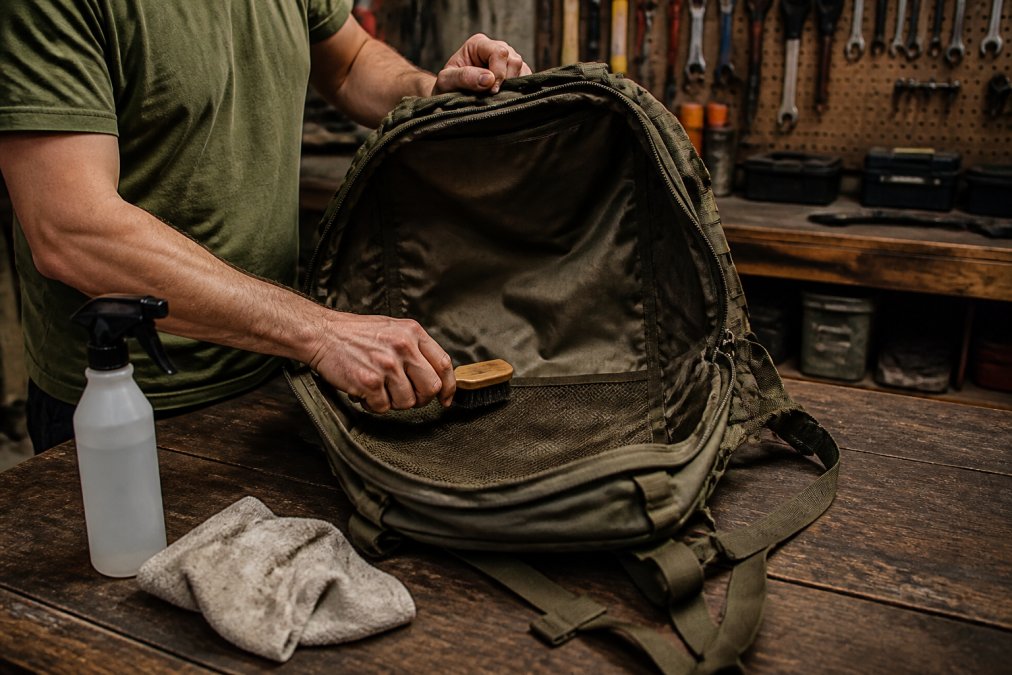
Material-Specific Cleaning Guide
Different materials demand different handling. This is where most generic advice falls apart.
- Nylon and polyester: Cool water, mild soap, soft brush. These tolerate a full soak.
- Cordura and ripstop: Same as nylon, but avoid scrubbing the DWR coating aggressively.
- Leather trim: Wipe only. Never soak leather, and never use soap on it.
- Mesh panels: Rinse thoroughly. Soap residue trapped in mesh attracts dirt.
Step 4: How to Get Gym Smell Out of Gear
Getting gym smell out of gear requires killing the bacteria, not just washing the fabric. That's the distinction that separates a bag that smells clean for a day from one that stays fresh for weeks.
Step 5: The Best Odor Eliminator for Tactical Gear
The best odor eliminator for tactical gear is one that destroys odor molecules at the source rather than masking them with fragrance. Look for bio-based formulas that are non-toxic and safe around kids and pets, especially if your gear lives near family spaces.
DIY vs. Bio-Based Solutions
DIY remedies have their place. Vinegar and baking soda are natural odor neutralizers that work well for surface-level smells and light maintenance. Vinegar's acidity disrupts some odor compounds, and baking soda absorbs moisture and neutralizes acids.
Step 6: Drying and Moisture Control
Drying is the step people rush, and it's the one that determines whether odor comes back. Mold and mildew need moisture to grow, so a damp bag stored in a closet will smell worse within a week than it did before you cleaned it.
Preventing Odor Before It Starts
The cheapest odor fix is prevention, but prevention is not just a list of habits. It is a storage protocol, and most guides stop at "air it out." The gap is what happens between uses, especially during off-seasons when a bag sits untouched for weeks or months.
Daily and Weekly Habits
- Air the bag out after every use instead of zipping it shut. Even 30 minutes of open air drops interior humidity noticeably.
- Rotate two bags if you train daily, so each gets a full drying cycle between uses.
- Store clean, dry gear only. Never put a damp item back in a bag, even briefly.
- Wipe down straps and shoulder pads weekly with a bio-based spray. These contact points hold the most sweat and are the first place odor returns.
- Replace desiccant packets every few months, or sooner in humid climates. A saturated desiccant stops absorbing and can begin releasing moisture back into the bag.
Long-Term Storage Protocol
Off-season storage is where odor problems are actually created, because a bag sealed in a bin for three months has no way to shed residual moisture. A simple protocol prevents that.
- Clean and fully dry first. Never store a bag that has not been washed and completely dried. Any trapped moisture becomes a mildew colony.
- Choose the right container. A breathable cotton storage bag or a ventilated bin allows air movement. A sealed plastic bin traps moisture and is the worst option for long-term storage.
- Keep it unzipped or partially open. Air circulation inside the bag matters as much as around it.
- Add fresh desiccant. One packet per compartment is a reasonable starting point; more in humid environments.
- Store in a stable, dry location. Avoid basements, garages, and attics where humidity and temperature swing. A climate-controlled closet is ideal.
- Inspect monthly. Open the bag, check for musty smell, and replace desiccant as needed. A quick inspection catches problems before they set in.
A Simple Storage Decision Matrix
| Storage Duration | Container | Desiccant | Inspection Cadence |
|---|---|---|---|
| Daily use | Open air or breathable bag | Optional | After each use |
| Weekly use | Breathable bag, unzipped | One packet | Weekly |
| Monthly use | Breathable bag, unzipped | One packet per compartment | Monthly |
| Off-season (3+ months) | Breathable bag or ventilated bin | Fresh packets, replaced quarterly | Monthly |
| Humid climate | Ventilated bin with airflow | Extra packets, replaced monthly | Every two weeks |
Why This Matters Beyond Smell
Frequently Asked Questions
Can you wash tactical gear bags in a washing machine?
Most tactical gear bags should not go in a washing machine. Agitation can damage zippers, straps, and water-repellent coatings. Instead, hand wash with a pH-balanced cleaner, use a soft brush for stains, and rinse thoroughly. For tough odors, spray with a bio-based odor eliminator like Zero Smell that breaks down odor molecules without harsh chemicals. Always air dry away from direct heat to protect fabric integrity.
What is the strongest odor eliminator for tactical gear?
The strongest odor eliminators don't mask smells; they neutralize them at the source. Look for bio-based formulas that use microorganisms or natural minerals to break down odor-causing bacteria. Zero Smell's spray and pouches are designed for tactical equipment, safe around pets and kids, and 99% effective. For bags, spray the interior and let it air dry. For storage, place a Z-Pouch inside to continuously neutralize odors.
How do you prevent mold and mildew in tactical backpacks?
Prevent mold and mildew by ensuring your tactical backpack is completely dry before storing it. After cleaning, air dry it in a well-ventilated area, away from direct sunlight. Use a desiccant pack or a moisture-absorbing pouch like Z-Pouch to control humidity inside the bag. Store in a cool, dry place, and avoid leaving damp gear in a stuffy locker or car trunk. Regular cleaning also removes organic matter that feeds fungal growth.
How to get rid of military surplus smell?
Military surplus smell often comes from long-term storage and microbial buildup. Start by airing the bag outside for 24 hours. Then wash it with a gentle, pH-balanced cleaner, focusing on seams and crevices. Rinse well and dry completely. For persistent odors, use a bio-based odor eliminator that digests odor-causing bacteria. Zero Smell's spray is safe on fabrics and effective on tough, embedded smells. Avoid bleach or harsh chemicals that can damage materials.
Tactical gear bags hold odor because bacteria, sweat, and moisture have nowhere to go. Break that cycle with a real cleaning routine, thorough drying, and a bio-based eliminator that destroys odor at the source. Zero Smell's non-toxic, fragrance-free formula is safe around kids and pets, works on gear, gym bags, and car interiors, and needs only a few sprays to get the job done. Get started with Zero Smell and keep your gear genuinely fresh, not just perfumed.