

Simple Solutions Pet Stain and Odor Remover Review: 2026 Guide
Table of Contents
- Simple Solutions Pet Stain and Odor Remover: A Straightforward Review
- Simple Solution Extreme Stain and Odor Remover vs the Standard Formula
- How to Remove Old Pet Stains from Carpet: A Step-by-Step Approach
- The Best Pet Stain Remover for Upholstery and Fabric
- Pet Odor Remover Safe for Pets: What to Look For
- Pricing Breakdown: Which Size Makes Sense for Your Home
- Conclusion: Is Simple Solutions Pet Stain and Odor Remover Worth It?
- Frequently Asked Questions
Last Updated: October 14, 2026
Simple Solutions Pet Stain and Odor Remover: A Straightforward Review
Pet messes are a fact of life for anyone sharing a home with a dog or cat. If you are searching for a simple solutions pet stain and odor remover, this review from Zero Smell breaks down what works, what to avoid, and how to treat stains and odors on carpet, upholstery, and hard floors.

Stain removal and odor elimination are two separate jobs. A solution can lift the visible mark and still leave the compounds that keep a pet returning. That is why repeat treatment matters, and why surface and stain type change your approach.
Simple Solution Extreme Stain and Odor Remover vs the Standard Formula
The difference between an extreme or oxy-charged formula and a standard one comes down to concentration, the cleaning agent, and how aggressively it targets set-in stains. Standard handles fresh, everyday messes; extra-strength or oxy-charged is built for older stains and stronger odors.
How the three common formula types compare:
| Formula Type | Best For | Active Cleaning Mechanism | Dwell Time | Scent Profile | Watch Out For |
|---|---|---|---|---|---|
| Standard | Fresh urine, vomit, diarrhea, everyday tracked-in messes | Enzyme blend that breaks down uric acid, proteins, and fats | 5-10 minutes on fresh stains | Often lightly scented or unscented | Struggles with old, set-in stains and heavy ammonia odor |
| Extreme / oxy-charged | Old marks, dark urine rings, strong lingering odor, multi-layer contamination | Enzyme blend plus an oxygen-based booster that lifts oxidized pigment | 10-15 minutes; may need a second pass | Usually a stronger fragrance to counter heavier odor | Oxygen boosters can lighten some dyed fabrics, patch test first |
| Hard-floor | Sealed hardwood, stone, tile, linoleum, brick, concrete | Surfactant and enzyme blend tuned for non-porous surfaces; no carpet-pile residue | 3-5 minutes; wipe rather than blot | Typically unscented or lightly scented | Not intended for carpet pile or unsealed grout; can streak if over-applied |
How to pick between them, by mess type:
- Fresh urine (under a few hours old): Standard formula. Uric acid crystals have not bonded deeply into fibers, so one enzymatic pass usually neutralizes the odor source.
- Old urine (dried, dark ring, ammonia smell): Extreme or oxy-charged. The oxidized pigment needs the oxygen booster, and crystallized uric acid salts need a longer dwell time to re-dissolve.
- Vomit and diarrhea: Standard for fresh, extreme for anything that has sat overnight. Protein-heavy messes feed odor-causing bacteria quickly, so speed matters more than strength.
- Hard floors (sealed wood, tile, stone): Hard-floor formula only. Carpet formulas can leave a tacky film on sealed wood and etch or streak natural stone.
How to pick between them, by surface:
- Cut-pile and loop-pile carpet: Standard or extreme. Both rinse or blot out of pile without leaving sticky residue that re-attracts dirt.
- Area rugs with a backing: Standard first, extreme only if the backing is colorfast, the oxygen booster is most likely to bleed dye.
- Sealed hardwood and laminate: Hard-floor formula. Excess liquid is the bigger risk, so apply to a cloth rather than directly to the seam.
- Natural stone (granite, marble, travertine): Hard-floor formula, and confirm the stone is sealed. Unsealed stone is porous and can absorb both the stain and the cleaner.
A common mistake is buying one formula and using it everywhere. A hard-floor cleaner is not the same product as a carpet and upholstery cleaner; the wrong one can dull a finish, leave residue, or fail to reach the odor source in fabric.
EPA Safer Choice program guidance on evaluating cleaning products
How to Remove Old Pet Stains from Carpet: A Step-by-Step Approach
Removing old pet stains from carpet requires patience and repeat treatment, because dried urine and odor-causing compounds bind deeper into fibers over time. Set-in stains need a slower, layered approach, the reason is chemical, not just mechanical.
Why old stains behave differently. Fresh urine is mostly water and urea, which blot up easily.
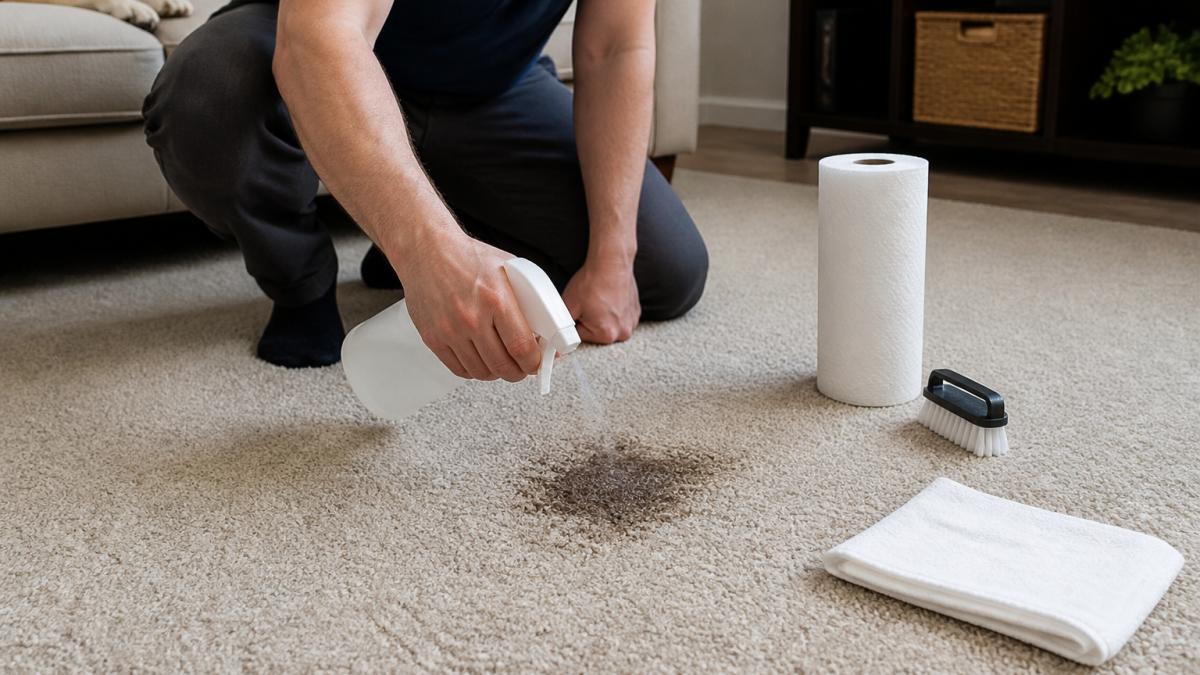
Step-by-step protocol for set-in stains:
- Identify the stain age and type. A dark ring with a crisp edge is usually old urine. A soft, spreading mark is more likely vomit or feces residue. This changes how much product you need.
- Blot any surface moisture with a clean, dry cloth. Press down and lift. Do not rub, rubbing pushes the stain deeper and spreads it sideways.
- Test the cleaning solution on a hidden patch of carpet first. A closet corner or under furniture works. Wait 5 minutes and check for color change or fiber damage.
- Apply the stain and odor remover generously, enough to reach the backing, not just the surface fibers. For a typical accident, that is roughly 1 to 2 ounces per spot. Under-applying is the most common reason old stains come back.
- Let the product dwell for 10 to 15 minutes on old stains. Fresh stains need only 5 minutes. Do not let it dry out, mist again if it starts to dry. Enzymes need moisture to stay active.
What to do when the stain is gone but the smell is not. Odor that survives visible stain removal usually means contamination reached the carpet pad or subfloor, and surface treatment will not fully solve it. Options, in order of cost and effort:
- Repeat the enzymatic treatment two more times over several days. This resolves most pad-level contamination that has not fully soaked through.
- Pull back the carpet and treat the pad and subfloor directly. If the pad is saturated, it may need replacing, pad is inexpensive relative to carpet.
- Use an ultraviolet blacklight to locate missed spots. Dried urine fluoresces under UV, revealing areas you may have overlooked, especially around baseboards and furniture legs.
For old stains, treat the area, let it dry, then treat it again the next day. The odor compounds that remain after the first pass are often what keep the smell coming back. A second and third pass is not a sign the product failed, it is how enzymatic cleaning is designed to work on set-in contamination.
The Best Pet Stain Remover for Upholstery and Fabric
The best pet stain remover for upholstery is formulated for fabric, safe around pets, applied with a light hand, and tested first. Couches, cushions, pet beds, and blankets absorb urine and odor differently than carpet, so the same product may behave differently on each surface.
When treating upholstery, keep these points in mind:
- Check the fabric care tag before applying anything.
- Test on a hidden area such as the back or underside of a cushion.
- Apply a light, even mist rather than soaking the fabric.
- Blot, do not scrub, to avoid pushing the stain deeper.
- Let the fabric dry fully, since damp fabric can hold odor.
This is where a surface-compatible, unscented product earns its place. Fragrance-free options matter for households with children, allergy sufferers, or anyone with chemical sensitivities. A fresh scent that masks a smell is not odor elimination.
ASPCA guidance on pet-safe cleaning and household products
Pet Odor Remover Safe for Pets: What to Look For
A pet odor remover safe for pets should be non-toxic, ideally unscented, free of harsh chemicals, and should neutralize odor at the source rather than covering it. Safety and effectiveness are not a trade-off when the formula is built correctly.
Look for these qualities:
- Non-toxic formula that is safe to use around children and pets.
- Unscented or fragrance-free, so it does not trigger allergies or mask odor with perfume.
- Bio-based or enzymatic action that breaks down the compounds causing the smell.
- Surface compatibility across carpet, upholstery, and hard floors.
- Clear directions so you apply it correctly the first time.
A common concern is whether non-toxic products work as well as heavy-duty chemical sprays. The answer depends on the formula.
Our own approach at Zero Smell follows this principle: a bio-based, non-toxic, unscented formula that neutralizes odors at the source and is safe around family and pets. For pet beds, blankets, kennels, litter boxes, carpet, and couches, that combination keeps a home genuinely fresh.
Pricing Breakdown: Which Size Makes Sense for Your Home
The right size depends on how many problem areas you treat and how often. A single spot treatment calls for a small bottle, while a whole-home approach with carpet, couches, pet beds, and a car interior justifies a larger one.
Here is how the sizes break down:
| Size | Price | Best For |
|---|---|---|
| 3.38oz / 100ml (single) | $9.98 | Testing on one spot or keeping in a bag |
| 3.38oz / 100ml (3 bundle) | $23.98 | Multiple rooms or vehicles |
| 16.9oz / 500ml | $19.98 | Regular household use |
| 33.8oz / 1000ml | $34.98 | Frequent treatment across several surfaces |
| 1 Gallon / 128oz | $69.98 | Whole-home use and heavy repeat treatment |
For most homes treating carpet, upholstery, pet beds, and a car interior, the mid-size bottle covers the job.
FTC guidance on truthful advertising and product claims
Conclusion: Is Simple Solutions Pet Stain and Odor Remover Worth It?
The honest answer is that results depend on matching the formula to the surface and stain type, and on giving enzymatic cleaners enough time and repeat passes to work.
If your priority is a non-toxic, unscented solution that neutralizes odor at the source and is safe around kids and pets, Zero Smell is built for exactly that.
Get started with Zero Smell and eliminate pet odors at the source, not just the surface.
Frequently Asked Questions
Does Simple Solution pet stain and odor remover work on old stains?
It depends on the formula and how long the stain has set. Standard formulas work best on fresh messes. For old, set-in stains and odors, an extra-strength or oxy-charged option is more effective because it breaks down the uric acid crystals that bond to carpet fibers over time. You may need repeat treatments for stains that have been there for weeks.
How do you use Simple Solution pet stain and odor remover on carpet?
Blot up as much of the mess as possible with a clean cloth. Shake the bottle, then spray the affected area generously. Let it sit for a few minutes so the enzymes or pro-bacteria can break down the stain and odor compounds. Blot again with a clean cloth and let the area air dry. For old stains, repeat the process after the first application dries.
Is Simple Solution pet stain and odor remover safe to use around pets?
Most formulas are labeled as safe for use around pets and children when used according to the product directions. That said, you should always check the specific label because ingredients vary between the standard, oxy, and hard-floor versions. Keep pets off the treated area until it is fully dry, and store the bottle out of reach.
What is the difference between Simple Solution and Simple Solution Extreme?
The standard formula handles everyday messes like fresh urine, vomit, and feces. The Extreme version uses a stronger concentration designed for tough stains, old odors, and set-in messes that the standard formula cannot fully remove. If you are dealing with a recurring spot or a smell that keeps coming back, the extra-strength option is the better pick.
Can Simple Solution pet stain and odor remover be used on upholstery?
Yes, it can be used on upholstery, but you should test a small hidden area first to check for colorfastness. Spray lightly rather than soaking the fabric, and blot instead of rubbing to avoid pushing the stain deeper into the fibers. Let the upholstery dry completely before letting pets back on the furniture.