

Why Traditional Air Fresheners Are Toxic: What's Inside
Table of Contents
- What Traditional Air Fresheners Actually Release Into Your Home
- The Dangers of Phthalates in Air Fresheners
- Secondary Pollutants: When Air Fresheners Create New Chemicals
- Why Some Households Are More Vulnerable Than Others
- How to Improve Indoor Air Quality Naturally
- What to Look for in the Best Natural Odor Eliminator 2026
- Frequently Asked Questions
Last Updated: September 17, 2026
What Traditional Air Fresheners Actually Release Into Your Home
Traditional air fresheners are products designed to mask or neutralize odors, and many of them release a complex mix of chemicals into the air you breathe. This guide from Zero Smell explains why traditional air fresheners are toxic, what those chemicals do once they're airborne, and how to protect your household without giving up a fresh-smelling home.
Here's the part most people never hear: the word "fragrance" on a label is legally allowed to hide dozens of individual chemicals. A single scented plug-in can emit a cocktail of volatile organic compounds that you never see listed anywhere on the package.
That's why traditional air fresheners are toxic in ways that aren't obvious from the label. The danger isn't one dramatic poison. It's the cumulative, daily exposure to a mix of chemicals that regulators largely don't require companies to disclose.
Volatile Organic Compounds and the Fragrance Loophole
Volatile organic compounds (VOCs) are carbon-based chemicals that evaporate into the air at room temperature, and air fresheners are a common indoor source of them. According to the Environmental Protection Agency's indoor air quality guidance, indoor concentrations of some pollutants can run several times higher than outdoor levels, and VOCs are among the main contributors.
The fragrance loophole makes this harder to track. Under federal labeling rules, companies can list "fragrance" as a single ingredient instead of disclosing the individual chemicals inside that blend, because fragrance formulas are treated as trade secrets. That means a product can legally contain formaldehyde, acetaldehyde, benzene, toluene, or 1,4-dichlorobenzene without naming any of them on the label.
A common mistake is assuming "unscented" means chemical-free. Unscented products often contain masking agents, which are fragrance chemicals added specifically to hide other odors. The result is the same class of airborne pollutants, just without a noticeable smell.
The Dangers of Phthalates in Air Fresheners
The dangers of phthalates in air fresheners come down to one thing: these chemicals are used to make fragrance last longer, and they're linked to hormone disruption. Phthalates are a group of chemicals that help scents cling to surfaces and release slowly over time, which is exactly what makes a plug-in smell strong for weeks.
That staying power is the problem. Phthalates are classified as endocrine disruptors, meaning they can interfere with the body's hormone signaling. They also tend to accumulate in household dust, so they linger in carpets, upholstery, and the air long after the product is unplugged.
How Phthalates Affect Children, Pets, and Hormone Function
Children and pets carry a heavier exposure burden than adults, and the reasons are practical rather than dramatic. Kids crawl on floors and put objects in their mouths, so they inhale and ingest more dust than adults do. Pets groom themselves constantly, swallowing whatever settles on their fur.
For pets specifically, this is a gap most articles skip.
Secondary Pollutants: When Air Fresheners Create New Chemicals
Secondary pollutants are new chemicals formed when air freshener ingredients react with other compounds already in your home, and they can be more irritating than what the product originally released. The key reaction involves ozone.
Why Some Households Are More Vulnerable Than Others
Not every home carries the same risk, and the difference usually comes down to who lives there and how the space is ventilated. Vulnerable populations absorb more of the same exposure than healthy adults do.
Here's how the risk stacks up by household:
| Household Factor | Why Risk Is Higher | Practical Fix |
|---|---|---|
| Infants and young children | Lower body weight, floor-level exposure, developing systems | Remove scented products from nurseries and play areas |
| Pregnant household members | Hormone disruption concerns during a sensitive window | Switch to fragrance-free odor control |
| Asthma and allergy sufferers | Fragrance acts as a direct respiratory trigger | Eliminate aerosols, keep ventilation high |
| Pet owners | Pets groom fur and inhale at close range | Avoid spraying on pet beds and furniture |
| Elderly family members | Often spend more hours indoors | Improve ventilation, reduce product count |
How to Improve Indoor Air Quality Naturally
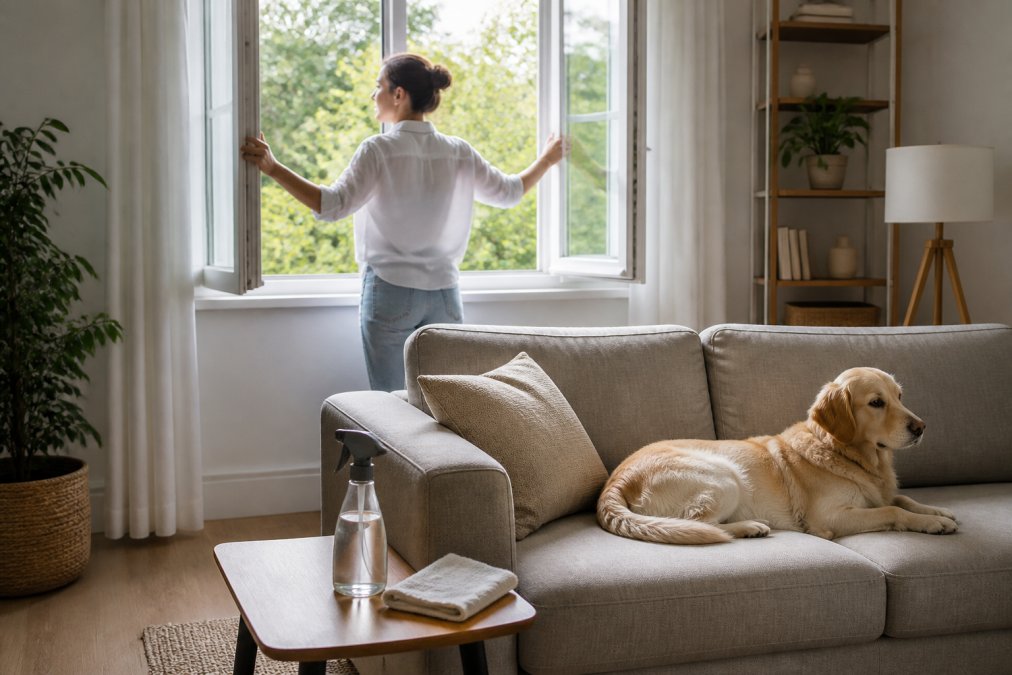
Improving indoor air quality naturally starts with removing the source of the chemicals, then adding ventilation and fragrance-free odor control. You don't need a lab to make meaningful changes, but you do need to understand why each step works so you can prioritize the ones that matter most in your home. Transitioning to a cleaner environment extends beyond the air you breathe, as incorporating natural fragrance alternatives into your personal care routine further reduces your total chemical exposure.
Step 1: Remove the Source First
Source removal beats every downstream fix. A plug-in that's still plugged in keeps emitting VOCs and phthalates no matter how many windows you open or filters you run. Pull the scented plug-ins, aerosol sprays, scented candles, wax melts, and scented garbage bags out of the house before you do anything else. Most households find two or three scented products they can drop immediately once they look.
Step 2: Ventilate With a Purpose
Opening windows for 10 to 15 minutes a day flushes accumulated VOCs and secondary pollutants, even in winter. The mechanism is simple: indoor concentrations of many pollutants run higher than outdoor levels, so a short cross-breeze dilutes the indoor air faster than the source can replenish it. Run kitchen and bathroom exhaust fans while cooking and showering, and leave them on for a few minutes after you finish.
Step 3: Filter What's Already Airborne
A HEPA filter captures particulate matter, including the ultrafine particles that form when terpenes react with ozone. Look for a unit sized to the room, and change or clean the filter on the schedule the manufacturer specifies. A HEPA filter does not remove VOCs or phthalates that are still off-gassing from a product, which is why source removal comes first.
Step 4: Control Odor Without Fragrance
Odor control and scent are two different jobs. Masking swaps one smell for another; neutralizing breaks down the odor molecules at the source. For everyday odor, wash pet beds, gym gear, and sports equipment regularly rather than spraying them, and choose fragrance-free cleaning products instead of "fresh scent" versions.
DIY Non-Toxic Scenting and Odor Control
- Baking soda absorbs acidic odor molecules. Leave an open box in a refrigerator, closet, or gym bag, and replace it every one to two months.
- Activated charcoal adsorbs a broad range of odor compounds. A small pouch in a locker, car, or trash can works the same way a HEPA filter works on particles, just at a smaller scale.
- White vinegar neutralizes many odor-causing compounds. A diluted spray on counters, sinks, and trash cans cuts odor without leaving a perfume trail; the vinegar smell fades as it dries.
- Simmer pots (water with citrus peel, cinnamon sticks, or herbs) add a light scent through steam rather than aerosolized fragrance chemicals. Keep the water level up and never leave a simmer pot unattended.
- Fresh air and sunlight remain the cheapest tools. Air out bedding, cushions, and rugs regularly rather than spraying them.
That explains the general approach. The harder part is figuring out which products are actually safe, because the label rarely tells you.
What to Look for in the Best Natural Odor Eliminator 2026
The best natural odor eliminator in 2026 is one that breaks down odor molecules at the source instead of covering them with scent. Masking swaps one smell for another. Neutralizing removes the problem.
- Z-Spray 16.9oz/500ml ($19.98) handles sport pads, shoes, helmets, pet beds, litter boxes, trash cans, and car interiors with a few sprays.
- Z-Spray 33.8oz/1000ml ($34.98) is the better value if you're treating gear, furniture, and vehicles on a regular basis.
- Z-Pouch & Case ($19.98 for three pouches with a case) works for lockers, gym bags, closets, and small enclosed spaces where a spray can't reach.
Frequently Asked Questions
What is the healthiest type of air freshener?
The healthiest option avoids synthetic fragrance entirely. Look for unscented, non-toxic odor eliminators that break down odor molecules instead of masking them with perfume. Products that list every ingredient, skip phthalates and formaldehyde, and carry no added fragrance are the safest bet for households with kids, pets, or chemical sensitivity. Ventilation and source removal still do most of the work.

Are there harmful chemicals in room fresheners that I should worry about?
Yes. Studies on common room fresheners have detected volatile organic compounds like formaldehyde, acetaldehyde, benzene, and toluene, plus phthalates hidden under the word 'fragrance.' These toxic air fresheners can trigger respiratory irritation, asthma symptoms, and long-term concerns around hormone disruption. If a label lists 'parfum' or 'fragrance' without detail, assume there is more in the bottle than the label shows.
What are the long-term health effects of inhaling synthetic fragrances?
Repeated exposure to synthetic fragrance has been linked to respiratory irritation, asthma triggers, and chemical sensitivity. Some ingredients act as endocrine disruptors, and compounds like 1,4-dichlorobenzene can accumulate in body tissue over time. People with pre-existing allergies, young children, and pets tend to show reactions first. Cutting scented products from the home is the simplest way to reduce that load.
How do VOCs in air fresheners affect indoor air quality?
VOCs raise the concentration of airborne pollutants indoors, where air circulation is limited. They can react with ozone to form secondary pollutants like formaldehyde and ultrafine particulate matter, which are harder on the lungs than the original fragrance. Improving ventilation, removing the source, and switching to a non-toxic odor eliminator reduces that chemical load and supports cleaner indoor air.
The challenge with traditional air fresheners is that the label gives you almost nothing to work with, so you're left guessing what's actually in the air your family breathes. Zero Smell takes the guesswork out with a bio-based formula that eliminates odors at the source, stays unscented, and is safe around kids and pets. If you're ready to swap masking sprays for real odor removal, get started with Zero Smell and treat your gear, home, and car with a solution built for the whole household.