

How to Eliminate Persistent Home Odors for Good
Table of Contents
- Why Some Home Odors Stick Around (and Others Don't)
- The Diagnostic Walkthrough: Pinpointing the Source Before You Treat It
- Neutralizing Odors at the Source vs. Masking Them
- The Best Natural Odor Eliminator 2026: What to Look For
- How to Remove Smells From Upholstery, Carpet, and Fabric
- Pet Odor Removal Techniques That Actually Work
- Ventilation, Humidity, and Air Exchange: The Fixes Most People Skip
- Conclusion
- Frequently Asked Questions
Last Updated: September 16, 2026
Why Some Home Odors Stick Around (and Others Don't)
Most persistent home odors have a physical source: odor molecules bind to porous surfaces, and until they're broken down or removed, the smell keeps regenerating. Eliminating persistent home odors starts with accepting that.
Three conditions make an odor stubborn:
- Porous surfaces absorb and slowly re-release odor compounds
- High humidity keeps molecules suspended and feeds microbial growth
- Low air exchange rate traps volatile organic compounds indoors
The Diagnostic Walkthrough: Pinpointing the Source Before You Treat It
Treating an odor you haven't located wastes money and time. A structured walkthrough narrows the source in under 30 minutes, and the key step is separating surface odors from structural ones, they require different responses.
Room-by-Room Odor Source Checklist
Work through each area methodically:
- Kitchen: under-sink cabinet, garbage disposal, refrigerator drip tray, range hood filter
- Bathroom: toilet base seal, shower curtain liner, exhaust fan grille, floor drain
- Bedrooms: mattress, pillow, closet floor, under-bed storage
- Living areas: sofa cushions, carpet padding, curtains, pet beds
- Basement or utility room: water heater pan, sump pit, HVAC closet, crawlspace access
- Garage or mudroom: gym bags, sports gear, trash cans, damp shoes
Surface Odors vs. Structural Odors: The Fork in the Road
The real diagnostic question is whether the smell lives on a cleanable surface or inside the building itself. Surface odors respond to cleaning, neutralizers, and ventilation; structural odors don't, and treating them alike is why so many households keep losing the same battle.
Structural odor sources fall into four categories:
- Crawlspace and basement moisture. A damp crawlspace with no vapor barrier feeds mold and bacteria year-round. The smell rises through floorboards and registers as "musty" above, even when those rooms are spotless.
- Plumbing vent and drain issues. A dry P-trap in a guest bathroom or laundry drain lets sewer gas in; a cracked vent stack or failed wax ring does the same. The giveaway is a smell that appears only in one bathroom or after running water elsewhere.
- Hidden mold behind drywall or under flooring. Water damage from a slow leak, past roof issue, or flooded basement can leave mold growing inside wall cavities for months. The smell is strongest near the affected wall and worsens in humid weather.
- HVAC ductwork contamination. Dust, moisture, and microbial growth inside ducts spread a house-wide odor whenever the system runs. If the smell appears only when the heat or AC kicks on, the ducts or evaporator coil are the likely source.
Signals That Point to a Structural Source
Any one of these patterns means you should stop cleaning and start investigating:
- The smell is strongest in one room regardless of how often you clean it
- It worsens after rain or in humid weather
- It appears only when the HVAC system runs
- It returns within hours of any surface treatment
- It has a sulfur, sewage, or damp-earth character rather than a stale or greasy one
How to Confirm a Structural Source Without Guessing
You don't need to open walls. A few low-cost checks do most of the work:
- Inspect the crawlspace or basement for standing water, damp insulation, or visible mold growth on joists and subflooring.
- Pour a cup of water down every floor drain in the home, including guest bathrooms and laundry rooms, to refill P-traps that may have evaporated.
- Check under every sink for slow leaks, discolored cabinet bottoms, or soft wood.
- Look at the HVAC closet or attic air handler for standing water in the drain pan or rust on the cabinet.
- Use a moisture meter on walls and floors near the odor. Readings above 15-16% on drywall or wood suggest active moisture intrusion.
Neutralizing Odors at the Source vs. Masking Them
Masking adds fragrance on top of the odor; neutralizing breaks the odor molecule apart. The difference shows up in how long the result lasts.
The Best Natural Odor Eliminator 2026: What to Look For
The best natural odor eliminator destroys odor molecules, works without added fragrance, and is safe around children and pets.
| Criterion | What to Look For | Why It Matters |
|---|---|---|
| Mechanism | Bio-based microorganisms or enzyme action | Breaks down odor molecules instead of covering them |
| Fragrance | Unscented or light citrus only | Fragrance-free matters for chemical sensitivities |
| Safety | Non-toxic, alcohol-free | Safe for use around kids and pets |
| Versatility | Works on fabric, hard surface, and gear | One product instead of five |
Match the Product to the Surface: Porous vs. Non-Porous
This step determines whether a neutralizer actually works. Odor molecules behave differently on porous and non-porous materials, so the same product applied the same way can fail on one and succeed on the other.
A Quick Material-by-Material Reference
| Surface | Porosity | Treatment Approach |
|---|---|---|
| Sealed tile, glass, stainless steel | Non-porous | Light spray, wipe, short dwell |
| Finished hardwood, laminate | Semi-porous | Moderate spray, 5-10 min dwell, test first |
| Painted drywall | Semi-porous | Moderate spray, allow to air dry fully |
| Carpet and rug fibers | Porous | Saturate to backing, extended dwell, airflow |
| Carpet padding | Highly porous | Treat at depth or replace |
| Upholstery foam | Highly porous | Saturate, dwell, dry with airflow |
| Mattress ticking | Porous | Light-moderate spray, full dry before remaking bed |
| Concrete, brick, grout | Hard but absorbent | Saturate, dwell, seal after drying |
| Unfinished wood, subfloor | Highly porous | Treat at depth; replace if saturated |
Why This Matters More Than Brand
Two households can buy the same neutralizer and get opposite results because one applied it to a sealed countertop and the other sprayed the surface of a urine-soaked carpet pad. The product didn't fail, the application did. Reading the surface before the label is a high-leverage habit in odor removal.
How to Remove Smells From Upholstery, Carpet, and Fabric
Fabric holds odor longer than any hard surface because its fibers trap molecules deep in the weave and foam backing, where surface spraying rarely reaches.
- Vacuum thoroughly with a HEPA filtration vacuum. This pulls loose debris and surface odor particles out of the fibers.
- Blot any stains with a clean cloth and cool water. Don't scrub; scrubbing pushes contamination deeper into the padding.
- Apply a bio-based neutralizer to the surface and let it sit. A few sprays are enough; saturation causes its own problems.
- Increase airflow with a fan or open window. Fabric that stays damp grows mildew, which replaces one odor with a worse one.
- Repeat after 24 hours if the smell persists. Deep-set odors often need a second application.
Pet Odor Removal Techniques That Actually Work
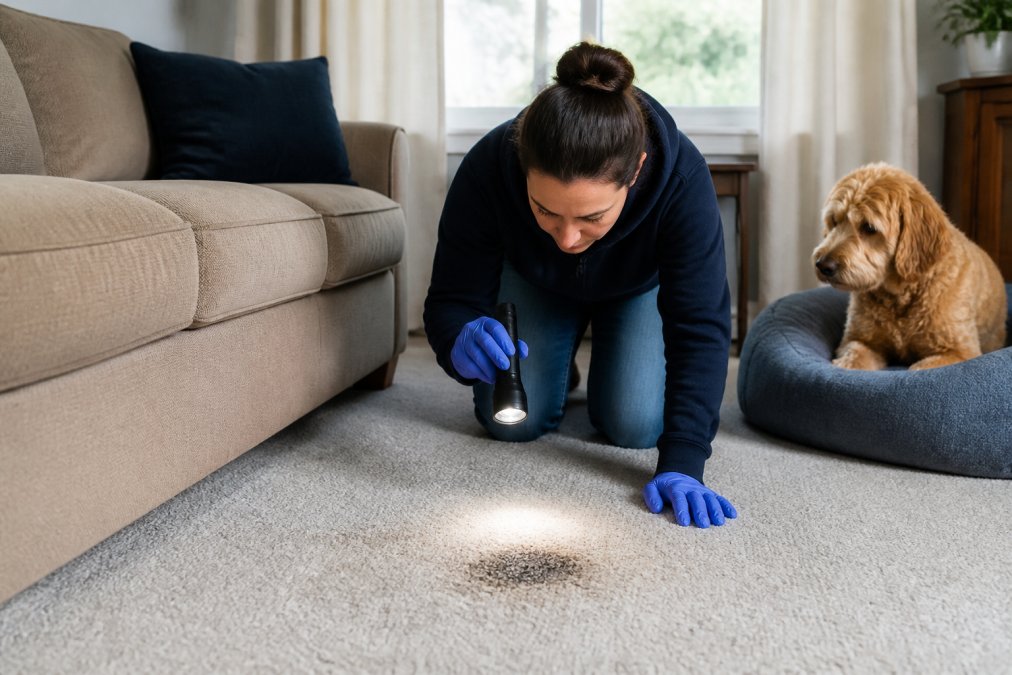
Pet odors return because the source isn't the visible stain: urine soaks through carpet into padding and subfloor, releasing odor for months.
- Find every spot with a UV flashlight. Urine glows under ultraviolet light, including old spots you never noticed.
- Treat at the deepest point first. For carpet, this means applying neutralizer to the padding, not just the surface fibers.
- Use a bio-based neutralizer rather than an ammonia-based cleaner. Urine contains ammonia compounds, and ammonia cleaners can signal pets to mark the same spot again.
- Wash all pet bedding weekly. Pet beds and blankets hold dander and oils that keep odors alive.
- Address litter boxes and kennels directly. Odors that cause pets to urinate in the same location need neutralizing at the source, not just cleaning.
Ventilation, Humidity, and Air Exchange: The Fixes Most People Skip
No amount of cleaning fixes a house that can't breathe. Ventilation and humidity control determine whether odors clear or settle in.
Three fixes deliver most of the benefit:
- Run bathroom and kitchen exhaust fans for 15-20 minutes after use, not just while you're in the room
- Keep indoor humidity between 30% and 50% with a dehumidifier in basements and damp rooms
- Replace HVAC air filters every 60-90 days and use a filter rated MERV 8 or higher for better particle capture
Conclusion
Persistent odors resist treatment because they live in porous materials, not the air, and no spray fixes a source you haven't found. Homeowners who solve this fastest diagnose first, treat the material rather than the room, and fix the ventilation that let the problem build.
Frequently Asked Questions
How do I remove extreme odor from a house when I can't find the source?
Start with a diagnostic walkthrough: check under sinks, behind appliances, inside HVAC vents, and around baseboards for dampness or discoloration. If nothing turns up, the source may be structural, such as sub-floor contamination or hidden mold behind drywall. A moisture meter and a flashlight at floor level help reveal what your nose alone cannot. Once you locate the source, treat it directly with an enzyme-based or bio-based product rather than spraying air freshener over the whole room.
What is the strongest odor eliminator for persistent home odors?
The strongest option is one that neutralizes odor molecules at the source instead of masking them with fragrance. Bio-based formulas use microorganisms to break down the compounds causing the smell, which means the odor cannot return once the surface dries. Look for products that are unscented, non-toxic, and safe around children and pets. For tough jobs like pet beds, gym bags, or car interiors, a concentrated spray applied directly to the surface works better than a diluted all-purpose cleaner.
What is the hardest smell to get rid of in a house?
Smoke, cat urine, and mold-related musty smells are the hardest to remove because they penetrate porous surfaces like drywall, sub-flooring, and upholstery. Cat urine contains uric acid crystals that bind to materials and release odor whenever humidity rises. Smoke particles lodge into every crevice, including HVAC ducts. Mold produces volatile organic compounds that keep regenerating until the moisture source is fixed. All three require source-level treatment, not surface spraying.
Are bio-based odor eliminators effective for pet smells?
Yes, when applied correctly. Bio-based formulas use beneficial microorganisms to break down the organic compounds in pet urine, feces, and dander. The key is saturation: spray enough to reach the bottom of the stain, not just the surface. For pet beds and blankets, apply the spray, let it work, and allow the item to air dry fully. This approach removes the odor that causes pets to urinate in the same spot, which is a problem masking sprays cannot solve.
How do I neutralize odors instead of masking them?
Masking adds fragrance on top of the smell; neutralizing breaks down the odor molecules themselves. To neutralize, first clean the surface to remove residue, then apply an enzyme-based or bio-based product that destroys the chemical bonds creating the odor. Ventilation and humidity control matter too: keeping indoor humidity below 50% prevents microbial growth that produces musty smells. If the smell returns after a few days, the source was not fully treated, so repeat the process.
Will a natural odor eliminator work on my car interior and my dog's bed?
A bio-based spray designed for multiple surfaces can handle both. For car interiors, spray seats, floor mats, and upholstery directly, then let the vehicle air out with windows open. For dog beds, remove the cover if possible and spray both the cover and the foam insert. The same product also works on gym gear, trash cans, and diapers. Check the label for safe use around pets and children before applying.