
How to Kill Odor Bacteria: 2026 Home Guide
Table of Contents
- What Causes Odor-Causing Bacteria and Why Smells Come Back
- How to Remove Bacteria Smell from Clothes
- The Best Odor Eliminator for Bacteria: What to Look For
- Step-by-Step: How to Kill Odor Bacteria on Gear, Shoes, and Surfaces
- Safety and Toxicity Profiles: What's Safe Around Kids and Pets
- Microbiome Balance: Why Killing All Bacteria Isn't the Goal
- Frequently Asked Questions
Last Updated: September 24, 2026
What Causes Odor-Causing Bacteria and Why Smells Come Back
Learning how to kill odor bacteria starts with understanding that the smell isn't the problem. The bacteria are.
Why Cleaning Alone Doesn't Kill the Smell
Regular detergent removes dirt and some surface bacteria, but it rarely reaches the biofilm buried inside synthetic fibers or foam padding. The rinse cycle pulls away loose debris, not the colonies anchored beneath it. Soap also leaves behind moisture, and moisture feeds microbial growth. A surface can look and feel clean while odor bacteria keep working.
How to Remove Bacteria Smell from Clothes
To remove bacteria smell from clothes, you need to break the bacterial colony, not just wash around it. Standard cycles often fall short because they don't address what's living inside the fabric.
Try this instead:
- Wash on the hottest setting the care label allows
- Skip the fabric softener compartment entirely; softeners coat fibers and lock in odor
- Add a half-cup of white vinegar to the rinse cycle to shift pH balance
- Dry completely, ideally in direct sun, since ultraviolet light is antimicrobial
- Treat stubborn items with a bio-based spray before washing
Material-Specific Protocols for Synthetic vs. Natural Fabrics
Synthetic fibers hold odor differently than natural ones. Polyester, nylon, and spandex trap oils in their structure, which is why gym gear keeps smelling even after washing. Natural fabrics like cotton and wool release oils more easily but absorb moisture and stay damp longer.
| Fabric Type | Main Challenge | Best Approach |
|---|---|---|
| Synthetic (polyester, nylon) | Traps oils and biofilm | Warm wash plus enzyme-based treatment |
| Cotton | Holds moisture | Hot wash, full dry cycle |
| Wool | Delicate, odor-absorbent | Cool wash, air dry, spot treat |
| Blends | Mixed fiber behavior | Treat as the most delicate fiber present |
The Best Odor Eliminator for Bacteria: What to Look For
The best odor eliminator for bacteria does one thing well: it destroys the source instead of covering it. Most sprays on a shelf are fragrances. They coat the nose, not the problem. To tell the difference, you have to know which mechanisms actually break down odor compounds, and which ones just sit on top of them.
The Four Mechanisms That Actually Work
Odor-causing bacteria produce volatile organic compounds, short-chain fatty acids, thiols, amines, and sulfur compounds, as metabolic waste. A real eliminator interrupts that chemistry in one of four ways:
- Enzymatic breakdown. Proteases, lipases, and amylases cleave the proteins, fats, and starches that bacteria feed on and that trap odor compounds. Enzymes are substrate-specific, which is why a protease-heavy formula works on sweat residue but does little for pet accidents.
- Microbial digestion. Beneficial spore-forming bacteria (common genera include Bacillus) colonize a surface, outcompete odor-causing strains for nutrients, and metabolize the volatile compounds directly. This is the slowest mechanism but the longest-lasting, because the colony keeps working after the spray dries.
- Oxidation. Hydrogen peroxide, chlorine dioxide, and ozone generators break molecular bonds in odor compounds. Fast and broad-spectrum, but oxidizing agents can bleach fabric, corrode metal, and irritate airways if misapplied.
- Encapsulation and adsorption. Cyclodextrins (the active in many fabric refreshers) trap odor molecules inside a molecular cage until washing releases them. Baking soda and activated charcoal work by adsorption. These reduce smell but do not kill bacteria, so the source returns.
Reading the Label Like a Formulator
Ingredient order matters. In the U.S., ingredients are listed by concentration, so the first two or three names tell you what the product mostly is.
- Water first is normal and fine, it is the carrier.
- "Fragrance" in the top two slots signals a masking product. Walk away.
- Enzymes appear as protease, lipase, amylase, or a proprietary "enzyme blend."
- Beneficial bacteria appear as Bacillus spores or "probiotic blend."
- Surfactants (often listed as ethoxylated alcohols or glucosides) help the actives penetrate biofilm; without them, enzymes sit on the surface.
- Alcohol (ethanol, isopropyl) evaporates fast and can leave a residue that re-feeds bacteria. Skip it for ongoing odor control.
Matching the Eliminator to the Surface
No single formula handles every job. A common pattern among cleaning professionals is to keep two or three on hand:
| Surface | Best Mechanism | Why |
|---|---|---|
| Laundry and activewear | Enzymatic | Breaks the oil and protein biofilm inside fibers |
| Carpet, upholstery, pet beds | Microbial | Keeps working between cleanings in porous material |
| Hard surfaces (counters, tile) | Oxidation or quat-based | Fast kill, no residue concern |
| Air and soft goods | Encapsulation | Traps airborne and surface odor without wetting |
What "Non-Toxic" Actually Means on a Label
The word "non-toxic" is not a regulated claim in the U.S. the way "antimicrobial" is. A more reliable signal is third-party certification. The EPA's Safer Choice program reviews every ingredient against human health and environmental criteria, and the EPA's Design for the Environment logo appears on products that meet similar standards. Look for either mark rather than trusting marketing copy.
Step-by-Step: How to Kill Odor Bacteria on Gear, Shoes, and Surfaces
The Universal Six-Step Sequence
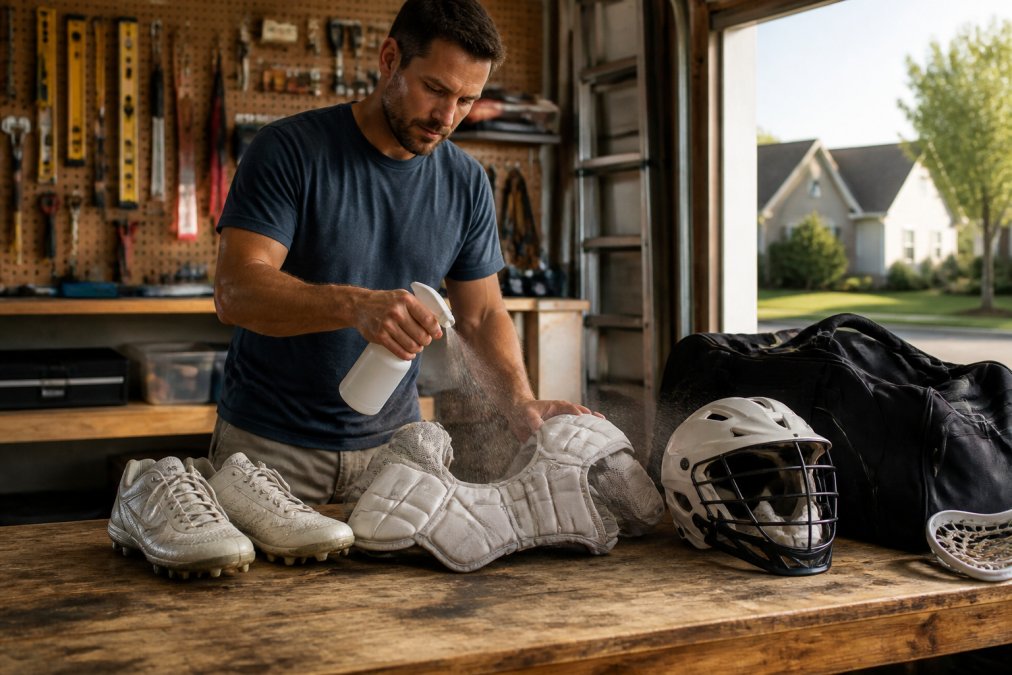
- Empty and air out. Remove everything from bags and gear. Let items sit in open air for at least 30 minutes to release trapped moisture. Sunlight helps, UV-A and UV-B damage bacterial DNA, but direct sun can fade dyes and degrade elastic, so limit exposure to 30-60 minutes.
- Brush off loose debris. Dirt, dried sweat, and dead skin feed bacteria. A stiff-bristle brush handles most surfaces; a soft brush for delicate fabrics.
- Apply your eliminator. Shake the bottle, then spray a light, even coat. Don't soak, oversaturation drives moisture into foam and padding, which is the opposite of what you want.
- Let it dwell. This is the step most people rush. Enzymatic formulas need 5-10 minutes of contact to cleave proteins and oils. Microbial formulas need the surface to stay damp for 15-30 minutes so the spores can germinate. Wiping immediately wastes the product.
- Dry completely. Moisture is the enemy. Air dry in moving air; a fan cuts drying time roughly in half versus still air. For thick foam, plan on 24-48 hours.
- Repeat for deep-set odors. Heavily soiled gear may need a second treatment after the first full dry cycle. If odor persists after two rounds, the biofilm is likely inside the material, not on it, see the material notes below.
Material-Specific Protocols
Treating every surface the same way is why some items never lose the smell. The table below is the short version; the notes after it explain the mechanism.
| Material | Temperature Limit | Dwell Time | Method Notes |
|---|---|---|---|
| Polyester, nylon, spandex | Warm (max 105°F wash) | 10 min enzymatic | Oils bind inside the fiber; pre-treat before washing |
| Cotton | Hot (up to 140°F) | 5 min | Tolerates heat and oxygen bleach; dry fully |
| Wool, silk | Cool (max 85°F) | 5 min, no agitation | Air dry flat; heat and agitation cause felting |
| Leather | Wipe only | 2-3 min | Never soak; condition after treating |
| Foam padding (helmets, pads) | Air only | 15-30 min microbial | Remove liners if possible; dry 48 hours |
| Mesh and technical knits | Warm | 10 min | Spray inside-out so active reaches the biofilm layer |
Footwear and Sports Equipment
Shoes and pads are the hardest items to fix because foam and padding hold moisture for days. Remove insoles and treat them separately, they are usually the worst offender. Spray inside the shoe, not just the outside, and aim the nozzle toward the toe box where sweat pools. For gear bags, spray the interior, leave the zipper open, and let it air for a full day before reloading.
Pet Beds, Car Interiors, and Soft Surfaces
Pet beds, car seats, and couches trap dander, oils, and moisture. Vacuum first with a HEPA-filter vacuum to lift loose debris and dander, then spray the surface and let it dry. For car interiors, target vents, floor mats, and the gap between the seat and center console, that crevice collects crumbs and moisture and is a common source of persistent smells. Leave windows cracked for a few hours after treating.
Safety and Toxicity Profiles: What's Safe Around Kids and Pets
The safest odor products avoid alcohol, harsh chemical sanitizers, and synthetic fragrance. Those ingredients can irritate skin, trigger allergies, and linger in the air long after spraying.
Microbiome Balance: Why Killing All Bacteria Isn't the Goal
Wiping out every microbe isn't the answer. Your skin and home have a natural microbiome, and a healthy balance keeps harmful bacteria in check. When you strip everything away with harsh chemical sanitizers, you clear the field for odor-causing strains to return stronger.
Frequently Asked Questions
Does hydrogen peroxide kill odor-causing bacteria?
Hydrogen peroxide does kill many odor-causing bacteria on contact, and it's a common household disinfectant. The catch is that it can bleach or damage colored fabrics, synthetic athletic gear, and some surfaces. It also leaves behind dead bacteria and their byproducts, which still smell until they're broken down and rinsed away. For everyday items like gym clothes, pet beds, and car interiors, a non-toxic, bio-based spray that neutralizes the source of the odor is often a safer choice.
Why do I still smell bad even though I have good hygiene?
Hygiene removes sweat and surface bacteria, but odor-causing microbes can survive deep in fabric fibers, shoe linings, and gear padding. Synthetic materials trap moisture and oils that feed microbial growth even after a wash. If your clothes or gear still smell after cleaning, the bacteria are likely living in the material itself, not on your skin. Treating the fabric with an odor eliminator that breaks down the source, not just the surface, is the step most people skip.
How do bio-based odor eliminators differ from chemical disinfectants?
Chemical disinfectants kill bacteria with harsh ingredients that can irritate skin, lungs, and pets. Bio-based odor eliminators use beneficial microorganisms and plant-derived enzymes to break down the compounds bacteria leave behind, including the volatile organic compounds that actually smell. That means they neutralize the odor at the source instead of masking it with fragrance. Zero Smell's formula is non-toxic, alcohol-free, and safe around kids and pets, which matters if you're treating gear and bedding they use daily.
Can odor-causing bacteria survive on fabrics after washing?
Yes. Standard laundry detergent removes sweat and surface grime, but it doesn't always kill the bacteria embedded in synthetic fibers, padded gear, or thick fabrics like pet beds. Those microbes can survive the rinse cycle and reactivate the next time the fabric gets warm or damp. To remove bacteria smell from clothes for good, wash on the hottest setting the fabric allows, skip fabric softener (it leaves a residue that traps odors), and treat the item with a bio-based spray after drying.
Will a non-toxic odor eliminator work as well as a heavy-duty chemical spray?
For most household odors, yes. The key is whether the product neutralizes the odor source or just covers it. Zero Smell uses bio-based microorganisms that break down the chemical bonds creating the smell, and the company reports it's 99% effective at eliminating odors. Chemical sprays may kill bacteria faster on hard surfaces, but they often leave behind dead bacteria and byproducts that still smell, plus they can irritate skin and airways. For fabrics, gear, and pet areas, a non-toxic option is the more practical long-term choice.
What's the best way to treat a gym bag or sports equipment that smells permanently?
Start by emptying the bag completely and wiping out any crumbs, dirt, or residue. Spray the interior, straps, and any padded gear with a bio-based odor eliminator like Zero Smell, then let it air out in a dry, ventilated space, not a closed closet. For shoes and helmets, spray inside and let them dry overnight. Repeat every few days until the smell is gone. For ongoing control, place a Z-Pouch in the bag or locker to keep odors from building back up between treatments.
Odor bacteria don't have to win. The trick is targeting the source, managing moisture, and skipping the harsh chemicals that make things worse. Zero Smell's bio-based Z-Spray neutralizes odors at the source, stays safe around kids and pets, and works with just a few sprays on gear, clothes, and soft surfaces. Get started with Zero Smell and eliminate the smell for good.