

How to Neutralize Pet Urine Smell in Carpet
Table of Contents
- How to Neutralize Pet Urine Smell in Carpet: A Step-by-Step Approach
- Step 1: Find and Identify Fresh and Old Pet Urine Stains
- Step 2: Blot Fresh Urine Immediately
- Step 3: Apply an Enzyme Cleaner for Pet Urine
- Step 4: Treat Old Pet Urine Smell in Carpet
- Step 5: How to Remove Dog Urine Smell from Carpet
- Why Carpet Smells Like Urine After Cleaning
- Common Mistakes to Avoid When Eliminating Pet Urine Odor
- Frequently Asked Questions
Last Updated: October 18, 2026
How to Neutralize Pet Urine Smell in Carpet: A Step-by-Step Approach
Pet urine creates one of the hardest smells to eliminate from carpet. The odor doesn't just sit on the surface, it soaks deep into fibers, padding, and sometimes the subfloor itself. That's why masking sprays and air fresheners fail. They cover the smell temporarily, but the source remains.
At Zero Smell, we understand this challenge. Pet owners struggle with urine odor because standard household cleaners don't break down the compounds that cause the smell.
The steps ahead address fresh accidents, set-in stains, and the stubborn odors that return after shampooing. You'll learn why some approaches fail and what actually works to eliminate the problem permanently.
Step 1: Find and Identify Fresh and Old Pet Urine Stains
You can't treat urine you can't find. Fresh accidents are obvious, wet spots and visible discoloration. Old urine hides. It dries into the fibers and padding, leaving only the smell as a clue.
Locating visible stains
Start with what you can see. Fresh urine appears as dark, wet patches on light carpet. On darker carpet, look for slightly discolored areas or damp spots. Press a white cloth against suspicious areas, if it picks up moisture or yellow staining, that's urine.
Check high-traffic pet routes: near doors, food bowls, litter boxes, and favorite sleeping spots. Pets often return to the same location, so multiple accidents cluster in the same area.
Finding hidden urine spots with a blacklight
A blacklight (also called a UV flashlight) reveals urine that's invisible to the naked eye. Urine fluoresces under UV light, showing up as bright spots or streaks on carpet fibers.
Here's how to use one:
- Darken the room completely by closing curtains and turning off lights
- Shine the blacklight slowly across carpet areas where you suspect urine
- Mark spots with tape or chalk so you can find them in normal light
- Check under furniture, in corners, and along baseboards, pets often have accidents in hidden areas
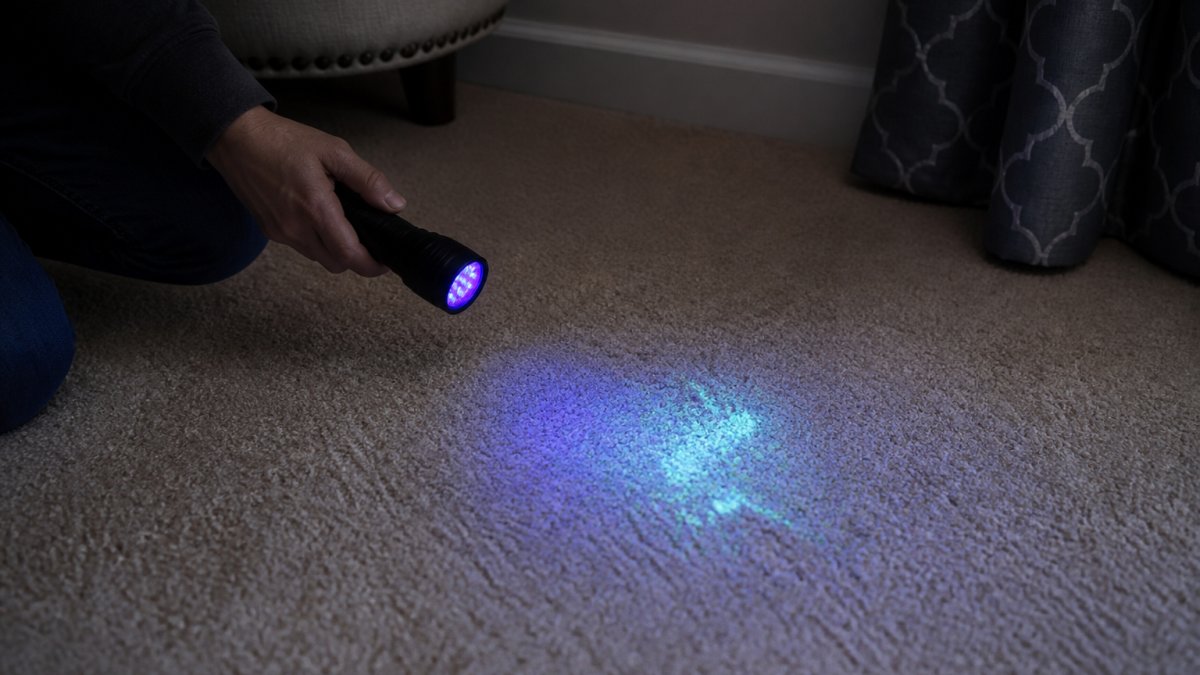
Many pet owners discover multiple spots they didn't know existed. This matters because treating one accident while missing others means the smell returns.
Step 2: Blot Fresh Urine Immediately
Fresh urine is easier to remove than old urine. The compounds haven't bonded deeply to fibers yet. Speed matters.
For wet spots:
- Blot with paper towels or cloth, don't rub, which pushes urine deeper into fibers
- Press down firmly to absorb as much liquid as possible
- Repeat with fresh towels until the area feels nearly dry
- Avoid walking on the wet spot, which spreads urine to surrounding carpet
This step alone removes much of the urine before it sets. Don't skip it, even if you plan to clean afterward.
For urine that's already drying:
- Dampen the area slightly with water to rehydrate it
- Blot again to pull out remaining urine
- Then proceed to Step 3
Step 3: Apply an Enzyme Cleaner for Pet Urine
Enzyme cleaners break down the organic compounds in urine, the source of the smell itself. They work differently than regular cleaners because they use biological enzymes to digest urine molecules.
Why enzymes work: Urine contains urea, uric acid, and other organic compounds. These create the smell. Regular detergents clean the surface but leave these compounds behind.
How to apply an enzyme cleaner:
- Saturate the stained area with the enzyme cleaner (follow the product instructions for dilution if needed)
- Let it sit for the time recommended on the label, usually 10-30 minutes
- Blot thoroughly with clean towels
- Rinse with water and blot again to remove all cleaner residue
- Allow to air dry completely
For best results, use a product specifically designed for pet urine. Zero Smell's formula uses bio-based materials that break down odor at the source rather than masking it.

Important: Don't rinse immediately after applying an enzyme cleaner. The enzymes need time to work. Rinsing too soon stops the process before it's finished.
Step 4: Treat Old Pet Urine Smell in Carpet
Old urine is stubborn because it's had time to soak into padding and sometimes the subfloor. Surface cleaning alone won't reach it. You need a multi-step approach.
For set-in stains that won't respond to enzyme cleaners alone:
- Apply enzyme cleaner as described in Step 3, but let it sit longer, up to several hours
- Blot thoroughly and rinse
- Apply a vinegar-and-water solution (equal parts white vinegar and water) to neutralize remaining odor
- Blot and allow to dry
- Sprinkle baking soda over the area to absorb any remaining odor
- Leave baking soda for 24-48 hours, then vacuum thoroughly
This layered approach addresses different compounds in old urine. The enzyme breaks down organic matter. Vinegar neutralizes remaining acidic compounds. Baking soda absorbs residual odor.
Addressing carpet padding and subfloor contamination
If urine has soaked through carpet into the padding below, you have a deeper problem. Padding traps moisture and odor, and once contaminated, it's nearly impossible to fully clean without replacement.
Signs of padding contamination:
- The smell returns within days after cleaning
- The area feels damp or spongy even after drying
- Multiple accidents in the same spot over time
- The smell is strongest when the carpet is wet (from humidity or cleaning)
If padding is contaminated, you have two options:
- Remove and replace the affected padding section (requires cutting out carpet, which is invasive and expensive)
- Treat aggressively with enzyme cleaner and accept that some odor may persist
For option 2, apply enzyme cleaner multiple times over several weeks. Each application breaks down more of the urine that's migrated into padding. This is a long-term approach but avoids carpet replacement.
Step 5: How to Remove Dog Urine Smell from Carpet
Dog urine presents specific challenges because dogs often have larger bladders, creating bigger wet spots. The smell is also typically stronger than cat urine.
Fresh dog urine:
- Blot immediately and thoroughly (dogs produce more liquid than cats)
- Use an enzyme cleaner designed for dog urine
- Allow extra drying time due to the volume of urine
Old dog urine:
- Follow the multi-step approach in Step 4
- Dog urine often soaks deeper, so padding contamination is common
- Multiple enzyme treatments may be needed
Dog urine also tends to return to the same spots. If your dog had an accident in a particular area, they may try to mark it again later. This is behavioral, the dog smells their own urine and feels compelled to go there again. Thorough odor elimination is essential to break this cycle.
After cleaning, monitor the area closely. If your dog returns to the same spot, the smell isn't fully gone. Retreat the area and consider additional steps like enzymatic treatment or professional cleaning.
Why Carpet Smells Like Urine After Cleaning
You've cleaned thoroughly, but the smell returns. This happens for specific reasons, and each has a different solution.
The smell returns because:
-
Urine reached the padding or subfloor, Surface cleaning doesn't reach deep contamination. The smell returns as humidity reactivates trapped urine compounds.
-
You didn't use an enzyme cleaner, Regular detergents clean dirt but don't break down urine compounds. The smell-causing molecules remain in the fibers.
-
The cleaner didn't sit long enough, Enzyme cleaners need time to work. Rinsing too quickly stops the process before it's complete.
-
You didn't fully rinse the cleaning product, Leftover cleaner residue can trap odor or create its own smell. Rinse thoroughly with clean water and allow complete drying.
-
Multiple accidents in the same area, Repeated urine exposure means more contamination. One cleaning pass won't remove it all. You may need multiple treatments.
-
Humidity reactivates dried urine, Even after cleaning, urine compounds can reactivate when carpet gets damp. This is why the smell seems to return after rain or after shampooing (which adds moisture).
The solution depends on the cause. If padding is contaminated, aggressive enzyme treatment or replacement is necessary. If you didn't use an enzyme cleaner, switch to one now. If humidity is the issue, improve ventilation and use a dehumidifier to keep carpet dry.
Common Mistakes to Avoid When Eliminating Pet Urine Odor
Pet owners make predictable errors that prevent successful odor elimination.
Mistake 1: Using regular carpet cleaner instead of an enzyme cleaner
Regular detergents clean visible stains but don't break down urine compounds.
Mistake 2: Not blotting fresh urine immediately
Every minute urine sits in carpet, it soaks deeper.
Mistake 3: Rinsing the enzyme cleaner too quickly
Enzymes need time to break down urine compounds. Rinsing after 5-10 minutes stops the process.
Mistake 4: Ignoring the padding
You can clean carpet fibers perfectly, but if padding is contaminated, the smell persists.
Mistake 5: Treating only the visible stain
A blacklight often reveals urine beyond the obvious stained area.
Mistake 6: Using too much water during cleaning
Mistake 7: Not allowing complete drying
Incomplete drying traps moisture and odor. Air dry carpet fully (24-48 hours) after cleaning.
Mistake 8: Assuming one cleaning will work
Old, set-in urine often requires multiple treatments.
Zero Smell's bio-based formula neutralizes odors at the source instead of masking them with fragrance. For best results on stubborn odors, apply Zero Smell to the affected area and allow it to work for several hours before blotting. The EPA recognizes bio-based products as safer alternatives to harsh chemicals for household use around families and pets.

Frequently Asked Questions
What removes strong urine smell from carpet?
Enzymatic cleaners break down the compounds causing urine odor at the source. After applying an enzymatic cleaner, use a bio-based odor eliminator like Z-Smell to neutralize remaining smells. For fresh urine, blot immediately with towels, apply the enzymatic cleaner, and allow it to sit for 24-48 hours. For set-in odors, you may need multiple treatments or professional extraction if the padding is saturated.
Why does carpet smell like urine again after shampooing?
Carpet shampooing often fails to eliminate pet urine because the odor-causing bacteria can survive in the padding and subfloor beneath the carpet fibers. If water and detergent don't fully saturate these layers, the urine compounds remain and resurface as the carpet dries. Using an enzymatic cleaner designed to break down urine compounds, followed by a bio-based odor neutralizer, prevents this rebound effect by addressing the root cause instead of just masking the smell.
Can you use an enzyme cleaner on pet urine in carpet?
Yes, enzyme cleaners are specifically designed for pet urine in carpet. They work by breaking down the proteins and uric acid crystals that create the odor. Apply the enzymatic cleaner directly to the stain, let it sit for 24-48 hours to allow the enzymes to work, then rinse thoroughly with water. For best results on old or set-in stains, combine enzymatic treatment with a non-toxic odor eliminator to neutralize any remaining smell.
How do you remove old pet urine smell from carpet that won't go away?
Old pet urine smell persists because urine has soaked into carpet padding and subfloor. Start by using a blacklight to locate all affected areas. Apply an enzymatic cleaner to saturate the stain completely, then let it work for 24-48 hours. After rinsing, spray a bio-based odor neutralizer like Z-Smell directly onto the carpet and padding. If the smell returns after shampooing, the padding may be permanently contaminated and require replacement or professional extraction.