

Non-Toxic Odor Eliminator for Pet Owners: Top Picks
Table of Contents
- Quick Comparison: Non-Toxic Odor Eliminators for Pet Owners
- How to Remove Dog Smell from House: A Surface-by-Surface Plan
- Best Enzyme Cleaner for Pet Urine: What to Look For
- Z-Smell Spray: The Non-Toxic Odor Eliminator for Everyday Pet Messes
- Z-Smell Pouches and On-the-Go Options for Small Spaces
- DIY vs. Commercial Odor Control: What Actually Works
- What to Avoid: Ingredients and Safety for Cats and Dogs
- Frequently Asked Questions
Last Updated: September 20, 2026
Quick Comparison: Non-Toxic Odor Eliminators for Pet Owners
A non-toxic odor eliminator breaks down odor molecules instead of covering them with fragrance, using ingredients safe around pets and children when used as directed. The biggest mistake pet owners make is reaching for a fragranced spray that masks the smell for an hour and leaves the source untouched. True neutralization provides a clean slate for your living space, allowing you to enjoy the subtle benefits of non-toxic home fragrance without the lingering chemical interference of synthetic masking agents.
Here's the short version before you read further:
| Product | Best For | Format | Price |
|---|---|---|---|
| Z-Spray 16.9oz/500ml | Everyday pet messes, couches, car interiors | Spray | $19.98 |
| Z-Spray 33.8oz/1000ml | Multi-pet homes and repeat use | Spray | $34.98 |
| 1 Gallon 128oz/4000ml | Whole-home and kennel use | Spray | $69.98 |
| Z-Pouch & Case | Litter boxes, kennels, small spaces | Passive pouch | $19.98 |
| Z-Pouch & Case (Single) | Testing one spot before committing | Passive pouch | $9.98 |
| Z-Smell On The Go (3 Bundle) | Gym bags, diaper bags, the car | Travel spray | $23.98 |
| Z-Smell On The Go (Single) | One bag, one locker | Travel spray | $9.98 |
How to Remove Dog Smell from House: A Surface-by-Surface Plan
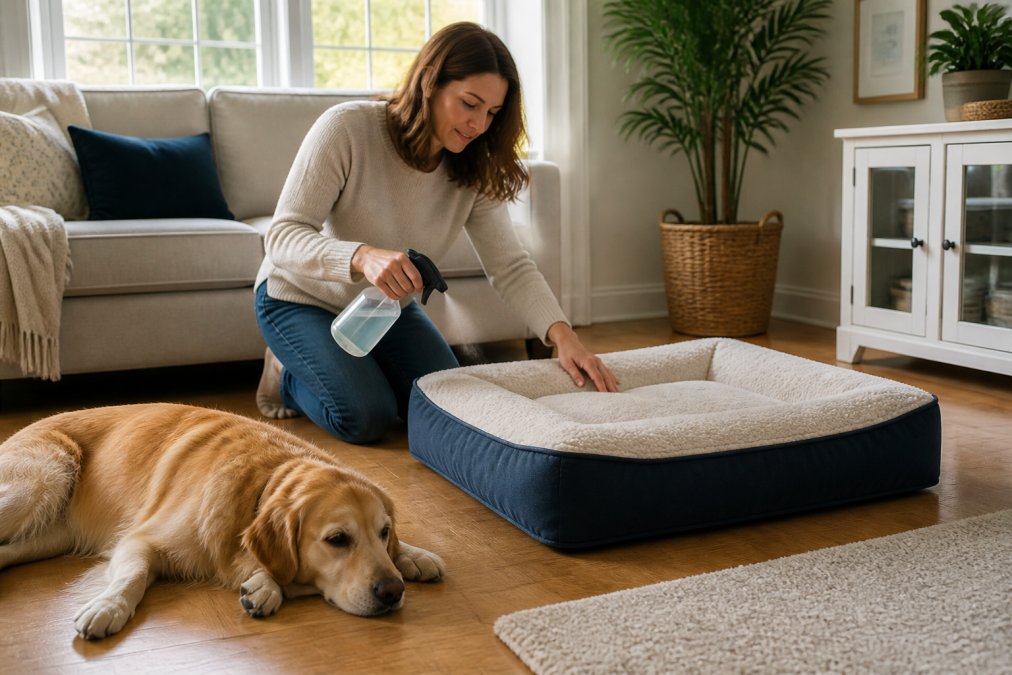
Removing dog smell means treating each surface by material: urine soaks into soft materials and sits on top of hard ones, so one plan doesn't fit a carpet, a hardwood floor, and a dog bed.

Carpet and Upholstery
Carpet and upholstery hold urine crystals deep in the padding, so surface spraying won't reach them. Blot while wet, then saturate to the depth the urine reached, most owners under-apply, and a light mist does nothing. Let it air dry; the product needs contact time to break odor molecules down.
Hard Surfaces and Pet Bedding
Hard floors, crates, and tile are easier because urine sits on the surface: wipe up, then spray and let it sit. For bedding, blankets, and pet clothes, spray directly and let dry; washables should still go through the wash, since the spray handles what the wash leaves behind. Kennels, litter boxes, and equipment bags respond well to the same approach, which is why the Z-Spray line lists all three among its intended uses.
Best Enzyme Cleaner for Pet Urine: What to Look For
The best enzyme cleaner for pet urine targets uric acid, which keeps re-crystallizing and re-releasing odor every time humidity rises. If a product doesn't address uric acid, the smell comes back. Check for:
- Uric acid targeting. This is the marker that separates a real cleaner from a deodorizing spray.
- Contact time instructions. A product that says "spray and wipe" isn't designed to break down urine crystals.
- Fragrance-free or unscented formulas. Fragrance hides the smell from you, not from your dog's nose.
- Surface compatibility. Some formulas are safe on carpet but not on leather or suede.
- Pet safety on the label. Look for explicit language about safe use around animals.
Z-Smell Spray: The Non-Toxic Odor Eliminator for Everyday Pet Messes
Z-Smell Spray is our top pick for most pet owners because it handles the widest range of surfaces with a single bottle. It's made with bio-based materials and beneficial microorganisms that break down the source of the odor instead of masking it, and it's unscented, non-toxic, and alcohol-free. Per the label, it covers pet beds and blankets, pet clothes, kennels, litter boxes, carpet, couches, bathrooms, trash cans, diaper bags, and car interiors, and it addresses the odor that causes pets to urinate in the same spot again.
Z-Spray Sizes and Pricing
Three sizes cover three households:
- Z-Spray 16.9oz/500ml at $19.98. Best for a single pet and occasional messes.
- Z-Spray 33.8oz/1000ml at $34.98. Best for multi-pet homes or weekly spot treatment.
- 1 Gallon 128oz/4000ml at $69.98. Best for kennels, fosters, or monthly bottle users.
Bundles pair a large bottle for the house with small ones for the car: 2 Spray Bottles 16.9oz/500ml + 3 Mini 3.38oz/100ml at $39.98, and 2 Spray Bottles 33.8oz/1000ml + 3 Minis 3.38oz/100ml at $69.98.
Z-Smell Pouches and On-the-Go Options for Small Spaces
Passive pouches solve a different problem than sprays: they work continuously in enclosed spaces where you can't spray every day. Z-Smell Pouches use minerals (bentonite and zeolite) plus active micro-organisms, and they carry a light citrus scent rather than being fully unscented. They earn their place in litter boxes, kennels, storage bins, linen closets, travel luggage, and gym lockers, hang one in the case, note the date with the included sticker, and let it sit; the longer it stays, the better it works.

DIY vs. Commercial Odor Control: What Actually Works
DIY odor control works for light, fresh odors and fails on set-in urine, chemistry, not effort. Knowing what each method does at the molecular level tells you when to reach for the pantry and when to reach for a formulated product.
What Baking Soda Actually Does
Sodium bicarbonate is a mild alkaline salt that adsorbs some volatile odor compounds and neutralizes acidic odors on contact, making it useful on fresh spills, in litter boxes as a base layer, and on upholstery as a pre-treatment. What it cannot do is penetrate: baking soda sits on top of the carpet fiber while urine from a soaked pad sits underneath, in the backing and subfloor.
What Vinegar Actually Does
White vinegar is dilute acetic acid that neutralizes ammonia-based odors (the sharp part of cat urine) by converting ammonia to ammonium acetate, which is far less volatile, fast and effective on hard, non-porous surfaces. Two limits matter: vinegar does not touch uric acid, the crystalline compound that re-releases odor every time humidity rises, and acetic acid is corrosive to natural stone (marble, travertine, limestone), aluminum, and some wood finishes. Test in an inconspicuous spot first.
What Commercial Bio-Based Eliminators Actually Do
Formulated bio-based eliminators combine three mechanisms DIY methods lack:
- Surfactants lower water's surface tension so the solution wicks to the same depth the urine reached, rather than beading on top.
- Enzymes or beneficial microorganisms break the molecular bonds in uric acid crystals and other odor compounds, converting them to compounds that no longer smell.
- Buffers keep the solution in the pH range where those enzymes stay active, which is why contact time matters more than concentration.
That third point is the one most owners miss. A product that says "spray and wipe" isn't formulated for enzyme activity, because enzymes need minutes of wet contact, not seconds. "Saturate and let air dry" tells you it's designed to work.
Side-by-Side: When Each Method Wins
| Situation | Best Method | Why |
|---|---|---|
| Fresh spill on hard floor | Vinegar, then wipe | Ammonia neutralizes fast; no penetration needed |
| Fresh spill on carpet | Blot, then bio-based spray | Surfactants reach the pad; enzymes handle residue |
| Set-in urine (returned-to spot) | Bio-based spray, saturated | Only enzymes break uric acid crystals |
| Litter box maintenance | Baking soda base layer | Adsorbs ongoing ammonia between full changes |
| Antique wood or stone | pH-neutral bio-based spray only | Vinegar etches; baking soda leaves residue |
| Silk or wool rug | Test first, then dilute bio-based spray | Alkaline and acidic DIY methods both risk fiber damage |
The Honest Trade-Off
For a fresh spill on a hard surface, DIY is fine and costs pennies. For a spot your dog has returned to three times, or a carpet that smells worse on rainy days, DIY won't fix it. The cost difference is real, but so is the difference between masking a smell for a week and eliminating it for good.
What to Avoid: Ingredients and Safety for Cats and Dogs
Most pet-safety guides list the same handful of offenders and stop there. The gap they miss is the household with a pet that already has asthma, allergies, or a compromised respiratory system, where "generally safe" isn't good enough. This section covers both the baseline avoid-list and sensitivity-specific guidance.
Why Cats and Dogs React Differently
Cats have a limited ability to glucuronidate certain compounds, a liver pathway many mammals use to clear drugs and chemicals (pubmed.ncbi.nlm.nih.gov). That's why cats are disproportionately sensitive to phenols, essential oils, and some common household disinfectants. Dogs metabolize many of the same compounds more efficiently, but their smaller airways and habit of sniffing surfaces at close range still make airborne irritants a real concern.
Baseline Ingredients to Avoid
- Phenols and phenolic compounds. Found in some pine-based cleaners and certain disinfectants. Particularly risky for cats.
- Heavy synthetic fragrance. A common trigger for respiratory irritation and contact dermatitis in both species. "Fragrance" on a label can represent dozens of undisclosed compounds.
- Bleach and ammonia-based cleaners. Harsh on airways and dangerous if accidentally mixed. Ammonia is also a component of urine, so ammonia-based cleaners can encourage re-marking.
- Concentrated essential oils. Tea tree, wintergreen, citrus, peppermint, and eucalyptus are among the most frequently cited as toxic to cats and dogs in concentrated form. Diffusers that run continuously in a closed room are a common source of low-grade exposure.
- Quaternary ammonium compounds (quats). Common in disinfecting wipes and floor cleaners. Effective against pathogens, but a frequent trigger for respiratory signs in cats and small dogs.
- Phthalates. Often hidden inside "fragrance" on an ingredient list. Associated with endocrine and respiratory concerns in sensitive animals.
If Your Pet Has Asthma, Allergies, or Chemical Sensitivity
If your cat has feline asthma, or your dog has environmental allergies, the bar for what you spray in the home is higher than "non-toxic." A few practical rules:
- Go unscented, not just "natural." Many plant-derived fragrances are as irritating to a sensitive airway as synthetic ones. Unscented is the safer default.
- Ventilate during and after use. Even a safe product releases volatiles as it dries. Open a window or run a fan for 15 to 30 minutes after treating a room.
- Keep the pet out of the treated area until dry. Wet product is the highest-exposure window. Once dry, most bio-based formulas leave little behind.
- Avoid aerosolized formats. Pump sprays produce larger droplets that settle quickly. Aerosol cans and continuous-mist devices produce fine particles that stay airborne longer and reach deeper into the airway.
- Patch-test new products. Spray a small, out-of-the-way area, let it dry fully, and watch your pet for 24 hours before treating a whole room.
- Watch for subtle signs. Coughing, sneezing, watery eyes, excessive grooming, or a sudden change in litter box behavior can all be reactions to something in the environment, not just the pet's own health.
Reading a Label Like a Safety Document
"Natural" on a label is not a safety guarantee. Some of the most toxic substances for cats are plant-derived. "Non-toxic" is also not a regulated term with a fixed definition, so it means different things from different brands.
What to look for instead:
- A full ingredient list, not a marketing summary.
- Explicit language about safe use around animals.
- "Fragrance-free" rather than "unscented" (unscented can still contain masking fragrance).
- Contact-time instructions, which tell you the product was formulated to actually work rather than just smell clean.
Frequently Asked Questions
What is the safest odor eliminator for pets?
The safest options are unscented, non-toxic formulas that break down odor molecules instead of masking them with fragrance. Look for products that are alcohol-free, biodegradable, and free of essential oils, which can be toxic to cats and dogs. Bio-based sprays like Z-Smell use microorganisms to neutralize odors at the source and are safe for use around pets and children when used as directed.
Are enzyme cleaners non-toxic for pets?
Most enzyme cleaners are formulated to be pet-safe once dry, but some contain fragrances or preservatives that can irritate sensitive animals. Always check the label for non-toxic, fragrance-free claims. If your pet has allergies or respiratory issues, choose a product with minimal ingredients and no added scent, and keep pets away from the treated area until it dries.
How can I get rid of pet smells without harsh chemicals?
Start by removing the source: clean accidents thoroughly, wash bedding regularly, and ventilate rooms. For lingering odors, use a non-toxic odor eliminator that targets uric acid and odor molecules on carpets, upholstery, and hard surfaces. Products like Z-Smell Spray are unscented and bio-based, so they neutralize odors without the harsh chemicals found in many air fresheners.
What ingredients should I avoid in pet-safe odor eliminators?
Avoid phthalates, synthetic musks, formaldehyde, and essential oils like tea tree, citrus, and peppermint, which are toxic to cats and dogs. Also skip products with strong artificial fragrances, as they can mask odors and irritate respiratory tracts. Instead, look for unscented, non-toxic formulas that list simple, biodegradable ingredients and are safe for use around pets.
Do bio-based odor eliminators work on deep-set pet stains?
Yes, but they work best when applied after the area is cleaned of excess liquid and debris. Bio-based formulas use microorganisms to break down the organic compounds in urine, feces, and sweat that cause odor. For deep-set stains, saturate the area and let it air dry; you may need a second application for old or severe odors. Z-Smell Spray is designed for pet beds, carpets, and kennels and eliminates odors that cause pets to re-mark the same spot.