
Lysol Pet Solutions Odor Eliminator: Does It Work?
Table of Contents
- What Lysol Pet Solutions Odor Eliminator Actually Does
- Lysol Pet Odor Eliminator Reviews: What Buyers Report
- Does Lysol Pet Odor Eliminator Work, or Just Mask the Smell?
- Pet Urine Odor Remover for Carpet: What to Look For
- How to Neutralize Pet Urine Smell in Carpet, Step by Step
- Pet-Specific Safety: Ventilation, Pets, and Kids
- Where It Works and Where It Doesn't: Surfaces and Odor Types
- Frequently Asked Questions
Last Updated: October 17, 2026
What Lysol Pet Solutions Odor Eliminator Actually Does
Lysol Pet Solutions Odor Eliminator is a spray designed to reduce pet odors on fabrics and hard surfaces while leaving a fresh scent. We hear the same question from pet owners constantly: does it remove the smell or just cover it up?
The product belongs to a category built around odor reduction and air freshening, not elimination at the source. That distinction matters more than most buyers realize.
The Fresh-Scent Variant and What's on the Label
The fresh-scent variant leans on fragrance to leave rooms smelling clean after application. Read the label closely before you buy: application directions, surface compatibility, and safety warnings vary by SKU. The EPA guidance on reading pesticide and cleaning product labels explains why those directions are legally binding, not suggestions.
Most cans in this category are sold in a 15-ounce size, often as a multipack. Price per ounce is the number worth comparing, not the shelf price.
Lysol Pet Odor Eliminator Reviews: What Buyers Report
Lysol Pet Odor Eliminator reviews tend to split along one line: how bad the smell was.
That pattern is consistent with how the product works. A spray treats the surface it touches. It does not reach the pad under the carpet where urine has pooled.
A common mistake is judging a product after one application on an old stain. Deep-set odors need extraction, not another layer of fragrance.
Does Lysol Pet Odor Eliminator Work, or Just Mask the Smell?
For light odors on hard, non-porous surfaces, it works as a surface treatment. For embedded odors in carpet padding, upholstery foam, or pet beds, it mostly masks.
Odor masking means adding a stronger scent to cover a smell. Odor neutralization means breaking down the compounds causing the smell.
If your goal is a room that smells clean for an afternoon, a scented spray is fine.
Pet Urine Odor Remover for Carpet: What to Look For
A good pet urine odor remover for carpet does three things: reaches the backing, breaks down uric acid crystals, and dries without leaving residue that attracts dirt. Fragrance is optional. Chemistry is not.
Use this checklist before buying any spray:
- Label states it neutralizes odors, not just freshens air
- Safe for the specific fabric or fiber you are treating
- No bleach or harsh oxidizers on wool or delicate upholstery
| Product Type | Best For | Limits | Watch Out For |
|---|---|---|---|
| Scented aerosol spray | Quick air freshening, light surface odors | Masks rather than removes | Lingering fragrance, pet respiratory irritation |
| Enzyme cleaner | Fresh accidents, washable fabrics | Needs dwell time to work | Ineffective on old, dried stains |
| Bio-based neutralizer | Set-in odors on carpet, upholstery, gear | Requires full saturation | Must reach the odor source |
| Baking soda + vacuum | Mild surface odor, routine refresh | Surface only | No effect on soaked-in urine |
How to Neutralize Pet Urine Smell in Carpet, Step by Step
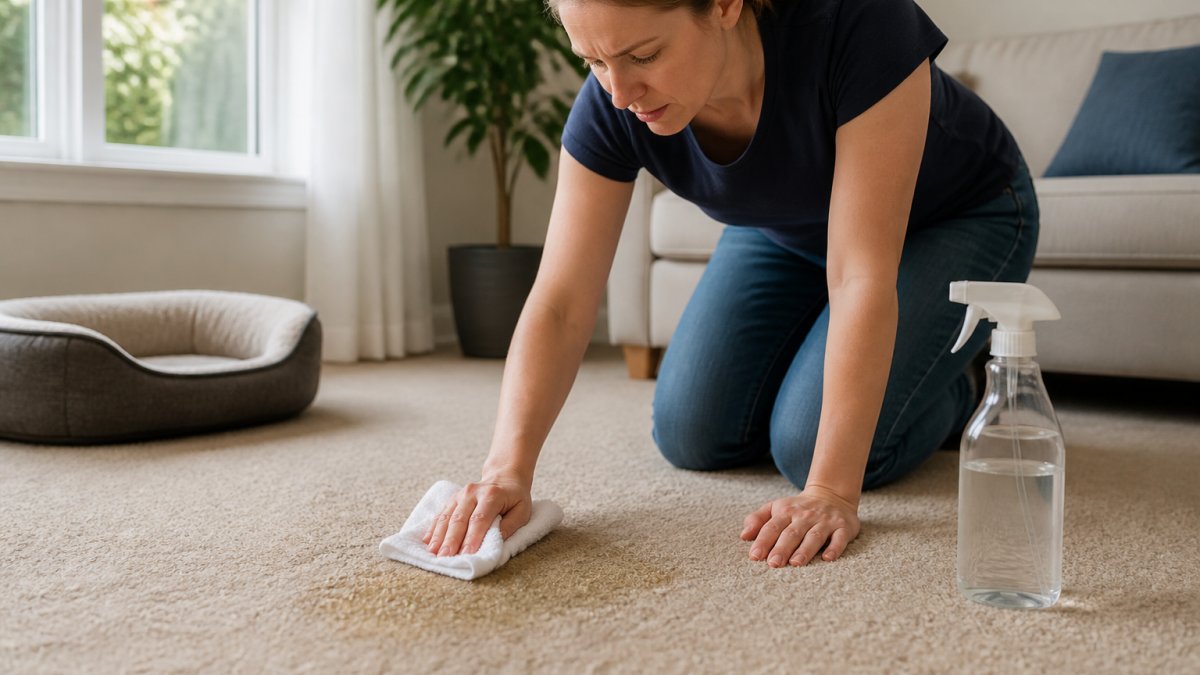
To neutralize pet urine smell in carpet, you must reach the urine, not the surface above it. Follow these steps in order.
- Find every spot. Use a UV blacklight in a dark room. Urine glows, and old accidents you forgot about will show up.
- Blot fresh accidents immediately. Press a clean cloth down and hold. Do not rub, which pushes urine deeper.
- Lift excess moisture. Apply pressure with a stack of towels or a wet/dry vacuum.
- Saturate the spot. Apply your neutralizer generously enough to reach the backing. Surface misting will not work.
- Respect dwell time. Follow the product label. Most neutralizers need several minutes wet to break down odor compounds.
- Blot and air dry. Ventilate the room and keep pets off the area until fully dry.
- Recheck with the blacklight. If the spot still glows, repeat once.
Pet-Specific Safety: Ventilation, Pets, and Kids
Most listings and reviews mention pet safety in a single line, if at all. A practical safety protocol is more useful than a warning label, so here is what to do before, during, and after any spray application in a home with pets or children.
Before you spray
- Read the label directions and warnings for your exact SKU. Application directions, surface compatibility, and precautionary statements vary by product and are legally binding under EPA guidance on reading pesticide and cleaning product labels.
- Move pets out of the room. Birds, reptiles, and small mammals are especially vulnerable to aerosol particles that settle on cages, food bowls, and water dishes. Cats and dogs groom themselves, so anything that lands on fur can be ingested.
- Open a window or run a fan. Cross-ventilation shortens how long aerosol particles and fragrance stay suspended in indoor air.
During application
- Keep pets and children out of the treated room until surfaces are dry. The ASPCA poison control guidance on household cleaners and pets recommends the same, and it is the single most important rule.
- Spray at the distance the label specifies, not closer. A heavy, close-range spray wets the surface unevenly and puts more product into the air.
- Do not spray toward a pet, a cage, or a water bowl, even briefly.
After application
- Let the surface dry completely before pets return. Drying time depends on the surface and humidity; a damp carpet or cushion is not ready.
- Ventilate until the fragrance fades. A lingering scent means particles are still in the air.
- Wash hands after handling treated fabrics or the container.
If accidental exposure happens
- On skin or fur: rinse with plain water. Do not rub, and do not let the pet lick the area.
- In eyes: flush with water for several minutes.
- If swallowed or inhaled: call your veterinarian or poison control immediately and have the product label in hand. Do not induce vomiting unless a professional tells you to.
For households with children or family members with fragrance sensitivities, a fragrance-free approach removes the most common trigger. A scented aerosol leaves fragrance in the air and on fabrics for hours; a non-toxic, bio-based formula with no fragrance layer is a lower-irritation option for the same surfaces. Customers like Ashley J. and Jacob R. have shared positive experiences regarding pets and kids being back in the room without worry.
A quick safety checklist
- Label read and directions followed
- Pets and children out of the room
- Window open or fan running
Where It Works and Where It Doesn't: Surfaces and Odor Types
Performance depends on both the surface and the odor. A spray treats the surface it touches; it does not reach the pad under the carpet where urine has pooled. That single fact explains most of the disagreement in buyer reviews, and it is the distinction most listings skip.
Performance by surface
| Surface | What the spray can do | What it cannot do |
|---|---|---|
| Sealed hard floors, tile, countertops | Sit on top and wipe clean; light surface odor lifts | Reach grout lines or seams where residue collects |
| Plastic pet carriers, crates, hard toys | Treat the surface and dry clear | Penetrate scratches or porous plastic |
| Upholstery and sofa cushions | Freshen the outer fabric and reduce surface odor | Reach foam underneath, where set-in odor lives |
| Curtains and bedding | Refresh the face fabric between washes | Replace laundering for soaked-in odor |
| Area rugs | Reduce surface odor on the pile | Reach the backing or pad |
| Carpet and carpet padding | Treat the top fibers | Reach the backing, where urine pools |
| Pet beds | Freshen the cover | Clean the fill, which holds odor |
| Mattresses | Freshen the ticking | Reach the foam core |
Where it works well: sealed floors, tile, countertops, plastic pet carriers, and light surface odors on upholstery.
Where it struggles: carpet padding, sofa cushions, mattresses, pet beds, and dried accident residue. The spray cannot reach the source, so the odor returns when the fragrance fades.
Performance by odor type
- Fresh accidents: respond to most products, including scented sprays, because the odor is still on the surface.
- Set-in urine: the uric acid crystals have dried into the backing or foam. A surface spray masks them; a neutralizer that reaches the source is required.
- Wet dog smell: comes from oils and microbes on fur and bedding. Surface spraying helps temporarily; washing the bedding and treating the source is what lasts.
Odor removal versus masking
Odor masking means adding a stronger scent to cover a smell. Odor neutralization means breaking down the compounds causing the smell. Most sprays in this category do the first. Fewer do the second. If your goal is a room that smells clean for an afternoon, a scented spray is fine. If your goal is a carpet that stops smelling like a dog, you need a product that reaches the source.
Surface treatment is not cleaning
A spray is a treatment, not a cleaning step. If the mess is still there, the spray is working on top of it. Remove solids and lift moisture first, then treat the surface, then let it dry. Skipping the cleaning step is the most common reason a product appears to fail.
Frequently Asked Questions
Is Lysol Pet Solutions Odor Eliminator safe to use around pets?
Follow the product label exactly: keep pets out of the treated room until the surface is fully dry, and ventilate while spraying. The label carries the manufacturer's directions for use around animals, and those directions take priority over any general advice online. If your pet has respiratory sensitivities or you are treating a bed the animal sleeps on daily, test a small hidden area first and let it dry completely before regular use.
Does Lysol Pet Odor Eliminator remove pet urine odor or just mask it?
It reduces odors on the surfaces listed on the label, but it is not formulated to break down urine salts that have soaked into carpet padding or subfloor. That is why a smell can return on humid days. For soaked-in accidents, a pet urine odor remover for carpet that neutralizes at the source, applied after blotting and rinsing, addresses the residue rather than the air above it.
What surfaces can Lysol Pet Solutions Odor Eliminator be used on?
The label lists hard, non-porous surfaces plus specific fabrics such as upholstery, bedding, curtains, and pet beds. Always spot-test an inconspicuous area of fabric first, since dyes and delicate weaves can react. Do not spray into carpet padding, inside electronics, or on surfaces the label does not name. For area rugs, spray lightly from a distance and let them dry fully before walking on them.
How does Lysol Pet Odor Eliminator compare with an enzymatic cleaner?
Enzymatic cleaners use biological agents to break down the proteins and uric acid in urine, which is why they are the standard for soaked-in carpet accidents. Lysol's product is a surface odor eliminator and air freshener, useful for quick refreshes on upholstery and hard surfaces. Many households keep both: an enzyme treatment for the accident site, and a spray for everyday odor control on pet beds, sofas, and car interiors.
A spray that only treats the surface leaves you chasing the same smell next week. If you want the odor gone at the source, Zero Smell's bio-based formula neutralizes odor compounds instead of masking them, stays safe around pets and kids, and works across carpet, upholstery, gear, and car interiors. Get started with Zero Smell and treat the smell once, not every week.