
How to Identify Toxic Ingredients in Cleaners: A Label-Reading Guide
Quick Summary
To identify toxic ingredients in cleaners, skip the front label and read the back, where the ingredient list and hazard signal word are printed. Watch for quaternary ammonium compounds, chlorine bleach, ammonia, phthalates hidden in fragrance, and formaldehyde-releasing preservatives. Words like natural or eco-friendly are not safety guarantees.
- Check the back or side panel first, since the front label is marketing.
- Look for the signal word Danger, Warning or Caution, which reflects immediate hazard.
- Names ending in ammonium chloride signal quaternary ammonium compounds.
- Never mix bleach with ammonia or vinegar, because the mixture can create toxic fumes.
- Check the safety data sheet and manufacturer contact before buying.
Table of Contents
- Why Cleaner Labels Are Harder to Read Than They Should Be
- Most Toxic Cleaning Ingredients to Avoid
- How to Read Cleaning Product Labels Step by Step
- Natural Versus Synthetic: Why 'Natural' Is Not a Safety Guarantee
- Checking EWG Cleaning Product Ratings and Other Resources
- Pet-Specific Toxicity and Hidden Allergens to Watch For
- Testing Your Own Cleaners and Disposing of Them Safely
- Choosing Your Next Cleaner: A Checklist to Use at the Store
- Frequently Asked Questions
Why Cleaner Labels Are Harder to Read Than They Should Be
Most people grab a cleaner, read the front, and never look at the back. That's a problem.
Confusing labels often leave families and pet owners guessing. Words like "natural," "plant-based," and "eco-friendly" sound reassuring, but none of them is a legal promise of safety.
Here's what makes the labels hard to read:
- Marketing terms appear in large type on the front.
- Ingredient names are often long and technical.
- Some ingredients are listed by their chemical family, not their everyday name.
- Safety information is printed in small type on the back or side.
Think of the front label as the sales pitch and the back label as the facts. Once you know where to look, the facts are easier to find.
Most Toxic Cleaning Ingredients to Avoid
Some ingredients show up again and again in cleaners that cause concern. Knowing their names helps you spot them quickly. Keep in mind that a single ingredient doesn't automatically make a product dangerous. Dose, concentration, and how you use the product all matter.
Quaternary ammonium compounds, chlorine bleach and ammonia
Quaternary ammonium compounds, often shortened to "quats," are common disinfectant actives. Look for names ending in "ammonium chloride." Chlorine bleach and ammonia are strong irritants, and mixing them with other cleaners can release dangerous gases.
Watch out: Mixing bleach with ammonia or vinegar can create toxic fumes. Read the label before you mix any two products.
Phthalates, formaldehyde and phosphates
Phthalates are used to make fragrances last longer, so they often hide inside the word "fragrance" or "parfum." Formaldehyde-releasing preservatives can irritate the skin and airways. Phosphates have been restricted in many areas because of their environmental effects on waterways. If you see these names, check whether the product is designed for your home's needs.
How to Read Cleaning Product Labels Step by Step
Follow these steps the next time you shop. Each one takes less than a minute, and together they turn a confusing back panel into a usable risk read.
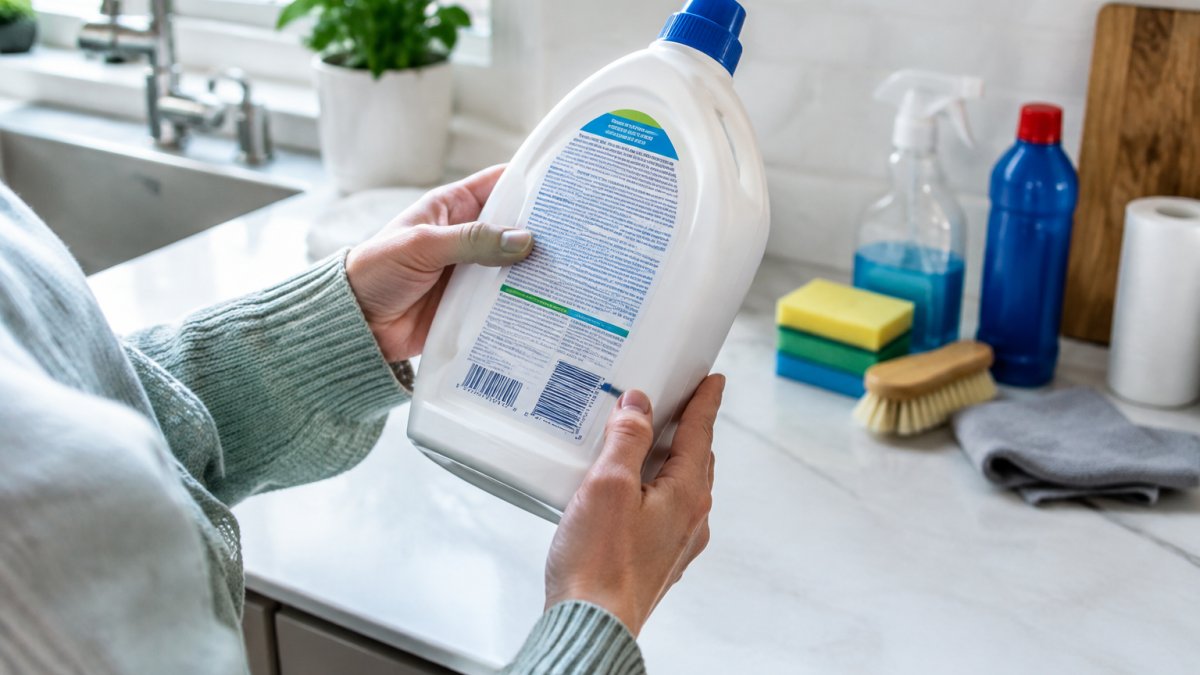
- Find the signal word first. Under the federal hazard communication standard administered by OSHA, a consumer cleaning product that carries a hazard must display one of three signal words: "Danger," "Warning," or "Caution." "Danger" marks the most severe hazards, "Warning" marks moderate ones, and "Caution" marks the least severe. A product with no signal word is not automatically safe, it may simply fall below the threshold that requires one.
- Locate the ingredient list. It is usually on the back or side panel, often in the smallest type on the bottle. If you cannot find a list at all, that itself is information: some formulators disclose only the active ingredients and lump the rest under "inert" or "other."
- Scan for the high-concern families named above. Quats (names ending in "ammonium chloride"), chlorine bleach, ammonia, phthalates hidden inside "fragrance," and formaldehyde-releasing preservatives are the first pass. Circle anything you do not recognize and look it up before you buy.
- Translate chemical-family names into everyday ones. Labels often list a family rather than a single substance, "nonionic surfactant," "anionic surfactant," "solvent," "pH adjuster." These are not automatically dangerous, but they tell you the product's job: surfactants lift soil, solvents cut grease, pH adjusters change how aggressive the formula is. A long list of families with no specific names is a sign the formulator is disclosing the minimum.
- Check for the manufacturer's contact information and a safety data sheet link. A safety data sheet, or SDS, lists ingredients, hazards, and first-aid steps in more detail than the label. Most manufacturers post them online. Ingredient disclosure on the label and the SDS together give the clearest picture. If a company will not share its ingredients, treat that as a warning sign.
- Compare two or three options side by side before you buy. The same product category, a bathroom disinfectant, a glass cleaner, a pet odor remover, can vary widely in which high-concern ingredients it uses. Reading three back panels in the aisle teaches you more than reading one.
Watch out: A "fragrance-free" claim is not the same as "unscented." A fragrance-free product may still contain masking agents, and an unscented product may contain a fragrance designed to smell like nothing. Read the ingredient list, not the front claim.
Decoding hazard statements: Danger, Warning and Caution
Hazard signal words are the fastest shorthand on the bottle, but they describe acute hazards, what happens if you swallow, splash, or inhale the product, not long-term exposure. A product can carry only "Caution" and still contain an ingredient linked to chronic concerns. Use the signal word to gauge immediate risk and the ingredient list to gauge the slower, cumulative ones.
Finding the safety data sheet and ingredient disclosure
A safety data sheet is written for workers, not shoppers, so it uses different language than the label. Look for Section 3 (composition) to see the ingredient names and concentration ranges, Section 4 (first aid) for what to do after an exposure, and Section 8 (exposure controls) for ventilation guidance.
The article's steps can be scanned quickly, so here is a summary of what to check on each step.
| Step | What to do | Time or frequency |
|---|---|---|
| Find the signal word | Look for Danger, Warning or Caution | Under a minute |
| Locate the ingredient list | Check the back or side panel | Under a minute |
| Scan high-concern families | Check quats, bleach, ammonia, phthalates, formaldehyde-releasing preservatives | First pass |
| Translate family names | Decode surfactants, solvents, pH adjusters | As needed |
| Check manufacturer and SDS | Confirm contact info and safety data sheet | Before buying |
| Compare two or three options | Read back panels side by side | In the aisle |
Natural Versus Synthetic: Why 'Natural' Is Not a Safety Guarantee
"Natural" sounds safer, but on a cleaning label the word has no strict legal meaning.
Here is how the common front-label terms actually work:
- "Natural" and "plant-based" are marketing terms. They describe the source of an ingredient, not its safety. Plant-derived surfactants can still irritate skin and eyes, and some natural essential oils are among the more sensitizing ingredients in a bottle.
- "Eco-friendly," "green," and "earth-safe" are not defined by any federal standard for cleaning products. A brand can print them without meeting any benchmark.
- "Non-toxic" is similarly unregulated on consumer cleaner labels. It is a claim, not a certification.
- "Biodegradable" has more grounding, federal rules govern how the term can be used for certain product categories, but it describes what happens after disposal, not what happens in your home.
- Third-party seals are the exception. Certifications such as the EPA's Safer Choice program, which reviews ingredient lists against a published standard, carry actual verification behind them (the EPA). A seal from a named program is worth more than any adjective on the front.
The better question is not whether an ingredient is natural, but what it is, how much is used, and how you will be exposed.
Watch out: Leafy imagery, soft colors, and the word "pure" are design choices, not disclosures. A bottle can look gentle and still list quats or fragrance on the back.
This is also where hidden allergens hide. Fragrance blends can contain dozens of undisclosed compounds, which makes them hard to avoid for anyone with sensitive skin or asthma.
Checking EWG Cleaning Product Ratings and Other Resources
Several independent groups rate cleaning products. The Environmental Working Group (EWG) maintains a database that scores products by ingredient hazard. Use these ratings as a starting point, not a final verdict. Compare the rating against the actual ingredient list. For a detailed look at one popular commercial product, read our review of Lysol Pet Solutions Odor Eliminator: Does It Work? Another useful comparison is Simple Solutions Pet Stain and Odor Remover Review: 2026 Guide, which shows how ingredient lists translate into real-world performance.
Pet-Specific Toxicity and Hidden Allergens to Watch For
Pets are more sensitive to some chemicals than people are. Cats in particular lack certain liver enzymes, which makes them vulnerable to compounds that are harmless to most adults. Essential oils, some phenols, and certain fragrance compounds can be dangerous to pets even at low levels.
Hidden allergens also matter for children. Fragrance blends can contain dozens of undisclosed ingredients, which makes them hard to avoid. For broader guidance on building a low-chemical home, see The Complete Guide to Non-Toxic Living for Families With Babies.
Testing Your Own Cleaners and Disposing of Them Safely
You don't need a lab to learn more about your cleaners. Start with a patch test on a hidden area of fabric or a small spot on a surface. Watch for discoloration, odor changes, or residue.
Disposal matters too. Don't pour leftover cleaner down drains unless the label permits it. Check your local household hazardous waste program, which many U.S. communities run for free. Keep products in their original containers, never in unlabeled bottles.
Choosing Your Next Cleaner: A Checklist to Use at the Store
Bring this checklist with you:
- Ingredient list is printed and easy to read
- No quats, chlorine bleach, or ammonia for general use
- "Fragrance" or "parfum" listed only if you're comfortable with it
- Signal word checked and matched to your use
- Safety data sheet or manufacturer contact available
- Ratings from independent sources compared
- Pet and child safety warnings reviewed
If you're shopping for an odor solution rather than a general cleaner, consider our 7 Best Non Toxic Odor Removers for Homes in 2026 for a shortlist to compare. You can also explore Cruelty Free Cleaning Products: 5 Picks for 2026 if animal testing is a concern.
Zero Smell's bio-based odor eliminator is designed to neutralize odors at the source instead of masking them, and it is formulated without harsh chemicals. Read the label, check the facts, and choose the option that fits your household.
Frequently Asked Questions
What ingredients should I avoid in household cleaners?
Start with quaternary ammonium compounds, chlorine bleach, ammonia, phthalates, formaldehyde-releasing preservatives and phosphates. Check the label for these names and look for hazard words such as Danger or Warning. Fragrance is also worth avoiding when you have sensitivities, because the word 'fragrance' or 'parfum' can hide dozens of undisclosed chemicals. Ingredient disclosure rules for cleaners vary, so if a product lists only 'fragrance' with no detail, consider it an unknown rather than a safe product.
How can I tell if a cleaning product is truly non-toxic?
No U.S. federal rule lets a cleaner be labeled 'non-toxic' without a defined standard, so the word alone tells you little. Read the full ingredient list, check the safety data sheet published by the manufacturer, and look for hazard statements on the label. A product with no hazard warnings and a full ingredient list is a stronger choice than one that only uses marketing words like 'natural' or 'green.' Third-party ratings can help you compare products side by side.
Are 'natural' cleaning products always safer than conventional ones?
No. Natural ingredients can still irritate skin, eyes or airways, and some essential oils such as limonene and linalool are known sensitizers. Conventional products can also be low in hazard if they are used as directed. Judge a cleaner by its specific ingredients, its hazard statements and how it is used, not by the word 'natural' on the front.
Is there an app that helps identify toxic ingredients in cleaners?
Several apps and online databases let you search a product or scan a barcode to see its ingredients and hazard ratings, and the EWG Skin Deep and Guide to Healthy Cleaning databases are widely used for this. Treat any app as a starting point. Confirm the key ingredients on the actual label and in the manufacturer's safety data sheet, because product formulas change over time.